 NK Mehta
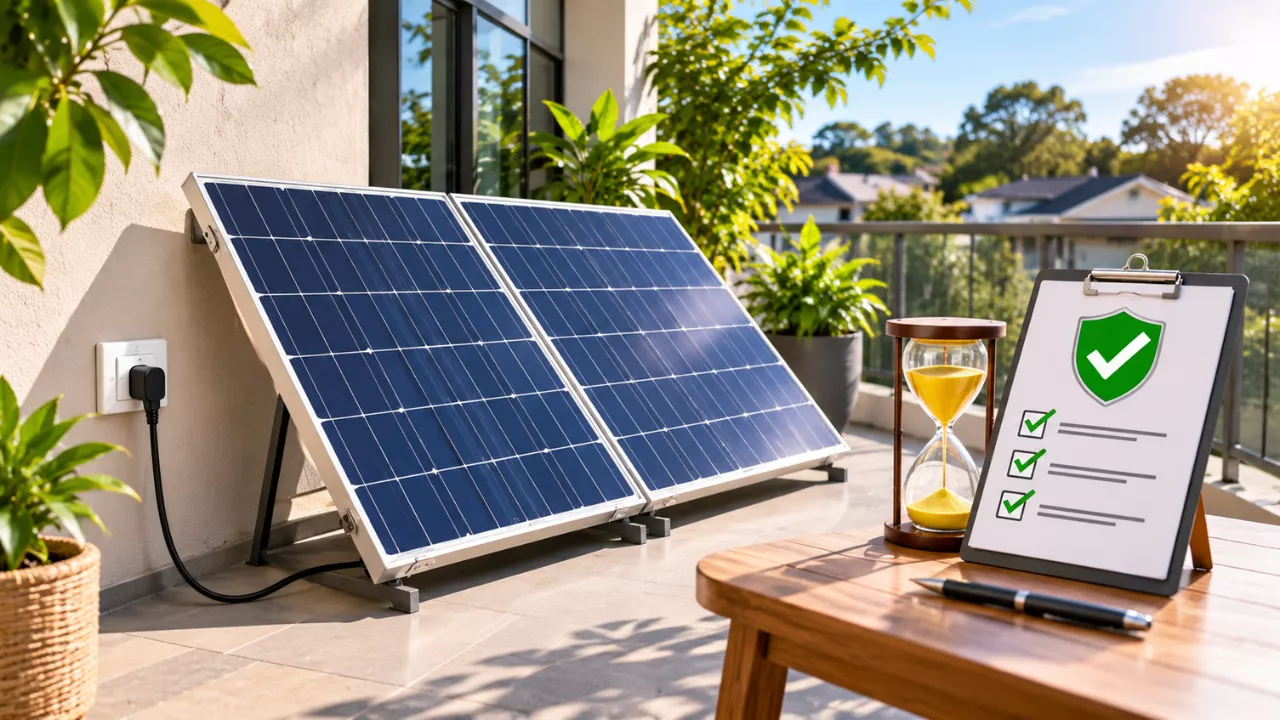
Plug-in solar in Australia sounds like the perfect fix for renters and apartment dwellers. You buy a small panel kit, hang it on the balcony and plug it into a power point. Your bills drop, and no rooftop installation is needed. The catch is simple, though. These systems are not legal to connect anywhere in the country yet.
Even so, kits are already being sold through online marketplaces. Western Australia has openly said that one goal of its new consultation is to steer households away from these uncertified products. In other words, people are buying them now. If you’re tempted to do the same, it pays to understand the risks first.
Is Plug-In Solar Legal in Australia Right Now?
The short answer is no. Any solar panel or battery that sends electricity back into your home’s wiring through a normal wall socket can’t be legally used in Australia today. Moreover, no certified plug-in products exist on the local market.
The main barrier is the national inverter installation standard, AS/NZS 4777.1:2024. It requires inverters to be permanently wired into a switchboard. Because of that rule, there is currently no way to test or certify a plug-in generator. Without certification, a product cannot be legally sold for this purpose.
However, change is on the way. Here is where things currently stand:
| Region | Current Position (Late 2026) |
|---|---|
| Western Australia | Consulting on a proposed standard and certification pathway; submissions close 9 December 2026 |
| National | Energy ministers agreed in September 2026 to explore safe pathways for plug-in devices |
| Other states and territories | No changes announced so far |
| Germany and the UK | Already legal, with approved products available |
WA hopes to become the first state to allow plug-in solar. Still, a legal pathway is not the same as products being ready on store shelves.
Why Are Plug-In Solar Kits Already Sold Online?
Buying a product and legally connecting it are two very different things. Global marketplaces make it easy to order electrical gear that was never designed for Australian homes. As a result, many shoppers assume that if something is for sale, it must be allowed.
Most kits on offer fall into two groups:
- Overseas-approved kits: These may meet German or UK rules. Yet Australian plugs, wiring and safety switches are different, so that approval doesn’t carry over.
- Uncertified kits: These cheaper products may not meet any recognised safety standard at all.
In Australia, nearly every consumer electrical product must display the Regulatory Compliance Mark (RCM). If a product lacks this tick logo, it hasn’t been shown to meet local safety requirements. Regulators also take this seriously. For example, WA’s Building and Energy issued $10,000 in fines in 2024 to sellers of unapproved chargers and power supplies.
So, if a seller claims a plug-in kit is “approved” for Australia, ask for proof. Right now, no plug-in generator can genuinely carry that approval here.
The Real Safety Risks of Uncertified Plug-In Solar
Household wiring was built to receive power, not to have it pushed back in through a socket. Certified products are engineered to manage that problem. Uncertified kits, on the other hand, offer no such guarantee.
Here are the key dangers:
- Safety switches may not work properly. Some residual current devices (RCDs) can fail to detect faults when DC current leaks into the circuit. Consequently, the risk of electric shock rises.
- Plug pins can stay live. If the inverter doesn’t shut off the instant it’s unplugged, the exposed pins could carry current.
- Electricians can be put at risk. A worker may switch off the board and assume a circuit is dead. Meanwhile, a plugged-in kit could still be feeding power into it.
- Wiring can overheat. Power added at the socket isn’t seen by the circuit breaker. Therefore, a large kit or several units on one circuit could overload the cabling.
- Batteries can catch fire. Cheap lithium batteries may lack proper cell protection.
System size matters a great deal. An 800 W system draws only about 3 amps, which sits comfortably within a standard 10 amp power point. Many online kits, however, are much bigger. For this reason, WA’s proposed standard would cap AC output at 800 VA and panel capacity at 2 kW, mirroring Germany’s approach.
If you already own a kit, unplug it. Then ask a licensed electrician to check your safety switches. Above all, never connect a solar device to a power board or extension lead.
Insurance, Warranty and Lease Problems to Consider
Even if nothing goes wrong electrically, an uncertified kit can still hurt you financially. Ironically, renters face the biggest exposure, even though plug-in solar is meant to help them most.
First, consider insurance. Many home and contents policies limit or exclude cover for damage caused by non-compliant electrical equipment. If a fire is traced back to an illegal kit, your claim could be refused. On top of that, you could be held liable for damage to neighbouring units.
Second, think about warranties. Products ordered from overseas sellers are often hard to return or repair. In most cases, there is no local support if something breaks. WA wants future approved systems sold by retailers with clear warranty duties, just like any other appliance.
Finally, check your lease and strata rules. Connecting generating equipment without permission could breach your rental agreement. In apartment blocks, by-laws may also restrict what you attach to balconies. Federal energy minister Chris Bowen has even described tenancy and strata rules as one of the hardest parts of legalising plug-in solar.
What to Look for When Approved Products Arrive
Once plug-in solar becomes legal, approved kits may look almost identical to the ones sold online today. The real difference will lie in testing, labelling and paperwork. Before you buy, run through this checklist:
- Certification to the relevant Australian plug-in standard
- The RCM logo on both the product and packaging
- Testing by a NATA-accredited laboratory
- Output within the legal limit, proposed at 800 VA in WA
- Documentation confirming instant shutdown when unplugged
- A local retailer offering a clear warranty
- A simple network notification form, which WA proposes for Western Power and Horizon Power customers
As for timing, WA’s consultation closes at 5 pm on 9 December 2026. After that, the state expects to publish its updated standard and certification route by around February 2027. Products will then need testing and approval, so they may take longer to reach shops.
Legal Ways to Save on Power While You Wait
Fortunately, you don’t need to wait for plug-in solar to start cutting your bills. Several legal options are available today.
- Free midday power plans: The federal Solar Sharer offer and Victoria’s Midday Power Saver give eligible households a few free hours of electricity around midday. Simply run your dishwasher and washing machine during that window.
- Portable power stations: These are legal because they never feed power back into your wiring. Charge one during cheap hours, then run appliances from it in the evening.
- Shared building solar: Some apartment blocks can share one rooftop system across several units, with owners corporation approval.
- A chat with your landlord: Solar adds value to rental properties, and rebates lower the upfront cost.
For many renters, shifting appliance use to free midday hours can deliver savings close to a small plug-in system. Better still, it costs nothing upfront.