 NK Mehta
Some places in Athens feel like museums. The Odeon of Herodes Atticus feels different, because it is still in use. This stone theater sits on the southwest slope of the Acropolis. Nearly 1,900 years after it was built, audiences still gather there on summer nights. They watch opera, classical concerts, ballet and drama under the open sky.
Also known as the Herodeion, the odeon is one of the best-preserved Roman-era monuments in Greece. It also connects modern visitors to the city’s long love of performance. This guide covers its history, design and famous moments. You will also find practical tips for seeing it yourself.
The History of the Odeon of Herodes Atticus
The theater was completed around 161 AD. Its builder, Herodes Atticus, was a wealthy Athenian scholar, teacher and public benefactor. He also held high office in the Roman Empire and funded many buildings across Greece.
However, this project was personal. Herodes dedicated the odeon to the memory of his wife, Aspasia Annia Regilla, who died around 160 AD. In that sense, the building is both a public gift and a memorial.
For roughly a century, the venue hosted music and gatherings. Then, in 267 AD, the Heruli invaded Athens and caused severe damage. Over the following centuries, the ruins were partly absorbed into the city’s fortifications. As a result, the theater lay largely unused for a very long time.
Architecture and Design of the Herodeion
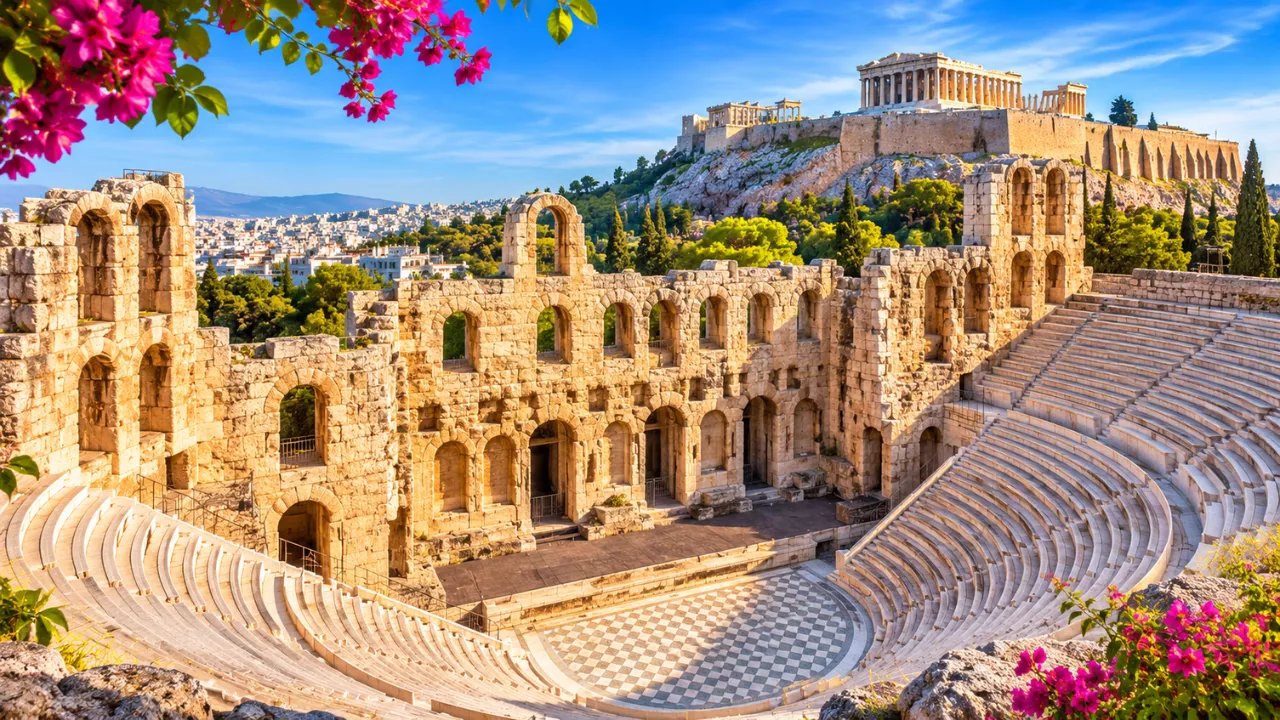
The odeon follows the classic Roman theater plan. Its steep, semicircular seating area, or cavea, is cut partly into the rock of the hillside. Below it lies a semicircular orchestra. Behind the stage rises a tall stone façade with arched openings. Today, that dramatic wall is the monument’s most recognizable feature.
The structure measures roughly 80 meters across. Estimates suggest it originally seated around 5,000 people. Notably, ancient writers describe a roof made of costly cedar wood. That covering would have made the odeon unusual, since most open-air theaters of the time had no roof.
What You See Today
The present seating is largely the result of restoration in the 1950s. During that work, the tiers and orchestra were rebuilt with marble. Meanwhile, the original stage wall was preserved as an authentic ruin. This blend of old and restored elements lets the venue function safely while keeping its ancient character.
Key Facts at a Glance
| Feature | Details |
|---|---|
| Official name | Odeon of Herodes Atticus (Herodeion) |
| Location | Southwest slope of the Acropolis, Athens, Greece |
| Completed | Around 161 AD |
| Built by | Herodes Atticus, Athenian benefactor |
| Dedicated to | His late wife, Aspasia Annia Regilla |
| Original capacity | Approximately 5,000 spectators |
| Major damage | 267 AD, during the Herulian invasion |
| Restoration | Seating and orchestra restored in the 1950s |
| Current use | Main venue of the Athens Epidaurus Festival |
A Living Stage: Famous Performances
The odeon returned to cultural life in the 20th century. Since the 1950s, it has been the heart of the Athens Festival, now called the Athens Epidaurus Festival. Each summer, the program brings Greek and international artists to this historic stage.
Several performances here became legendary. For example, Greek-American soprano Maria Callas sang at the venue in the 1940s and again in 1957. Later, in 1993, Yanni recorded his famous “Live at the Acropolis” concert here. Many renowned orchestras, ballet companies and theater troupes have also performed under the Acropolis.
What makes these evenings special is the setting. The lit stone wall glows against the night sky. Above it, the Acropolis rises in view. Few venues in the world offer that combination of sound, history and atmosphere.
Visiting the Odeon of Herodes Atticus
The theater is not open for casual walk-in tours like many ruins. Instead, there are two main ways to experience it.
Ways to See the Odeon
- View it from above: The path up to the Acropolis offers excellent views over the seating and stage.
- See it from the street: The pedestrian road of Dionysiou Areopagitou passes nearby, offering a glimpse of the stage wall.
- Attend a performance: This is the only way to sit inside and feel the venue’s full scale.
Practical Tips for a Performance
- Book early: Popular events sell out quickly, so check the festival program well in advance.
- Bring a cushion: The marble seats are hard, and some visitors find a small cushion helpful.
- Choose flat shoes: The steps are steep and uneven, especially in the upper tiers.
- Arrive on time: Entry can be slow, and late arrivals may wait for a suitable break.
- Respect the rules: Photography and food rules vary by event, so follow staff guidance.
The festival season usually runs through the summer months. Therefore, plan a trip between early summer and early autumn if you want to attend a show.
Why the Herodeion Still Matters
Many ancient monuments survive only as silent stone. By contrast, the Odeon of Herodes Atticus still fulfills its original purpose. It remains a place where people come together for music and storytelling.
That continuity is rare. Moreover, it offers a unique way to engage with ancient Greece. You do not just look at history here. Instead, you sit within it, listening as performers did nearly two thousand years ago.
Frequently Asked Questions
1. Who built the Odeon of Herodes Atticus?
Herodes Atticus, a wealthy Athenian benefactor, built it around 161 AD. He dedicated it to his late wife, Aspasia Annia Regilla.
2. Can you visit the Odeon of Herodes Atticus without a ticket?
You cannot enter freely, but you can view it from the Acropolis path. To sit inside, you need a ticket for a performance.
3. How many people does the Odeon of Herodes Atticus hold?
It originally seated about 5,000 people. Today’s capacity depends on the event and current safety arrangements.
4. When are performances held at the Herodeion?
Most events take place during the summer, as part of the Athens Epidaurus Festival.