 NK Mehta
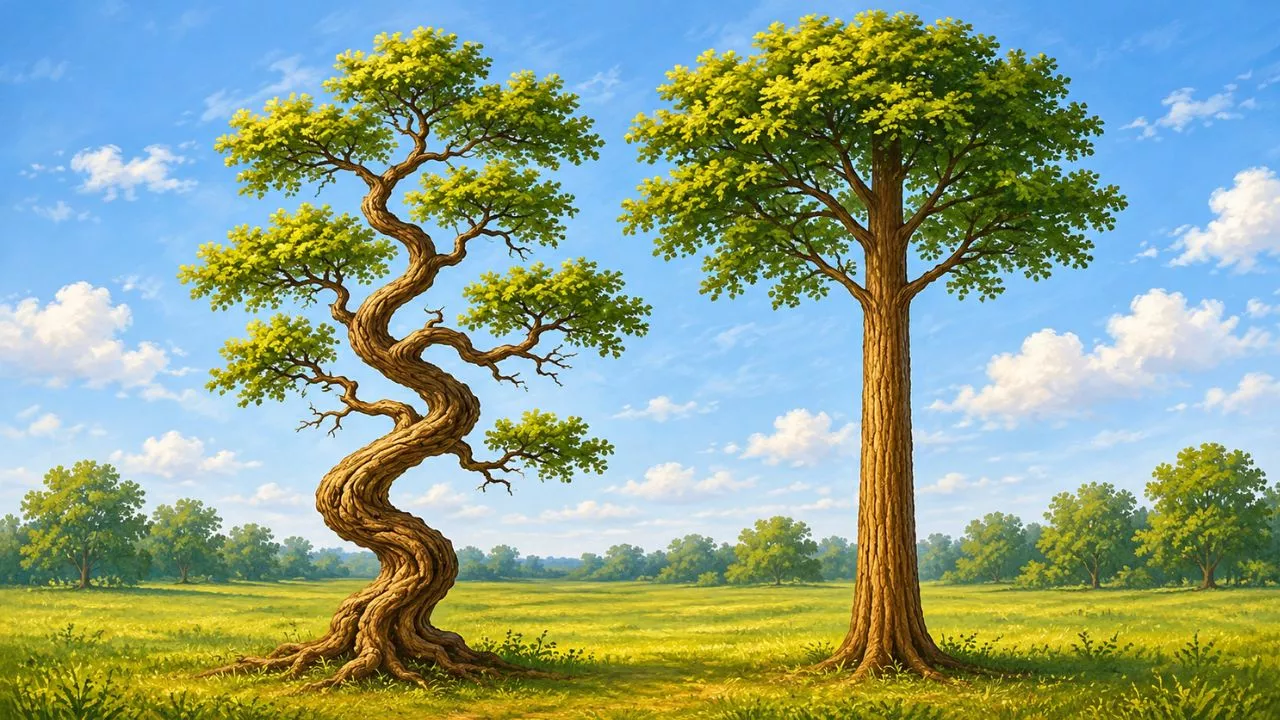
Walk through any old forest and you will notice something odd. The tallest, straightest trees are often the ones missing. Meanwhile, the bent and twisted trees still stand, sometimes for centuries. That simple observation sits at the heart of a well-known saying: a crooked tree lives its own life, but a straight tree becomes timber.
The line has recently drawn attention again on social media. However, the idea is far older than any post. It reaches back more than two thousand years to Chinese philosophy. It also holds up surprisingly well when you look at how real forests are managed today.
Where the Saying Comes From
The saying echoes the teachings of Zhuangzi, a Daoist philosopher who lived in China around the 4th century BCE. His writings return again and again to one theme: the usefulness of being useless.
In one well-known story, a master carpenter passes a giant sacred oak. His apprentice is amazed by its size. The carpenter, though, dismisses it. Its wood is knotted and poor, so nobody can build anything from it. That night, the tree appears to him in a dream. It explains that its “uselessness” is exactly why it has survived to such an old age.
Another passage makes the point even more directly. It notes that the straight tree is the first to be cut down, and the sweet well is the first to run dry. In other words, the qualities that make something valuable to others can also lead to its destruction.
What the Crooked Tree Saying Really Means
At first glance, the proverb sounds like an argument for laziness. That reading misses the point. Instead, it asks a quieter question: who benefits from your usefulness?
A straight tree fits neatly into someone else’s plan. It becomes beams, planks, and furniture. Its life ends the moment it matches what the market wants. By contrast, the crooked tree is ignored. As a result, it keeps growing on its own terms, providing shade, shelter, and seeds.
Here are a few ways people apply the idea today:
- Personal identity: Fitting every expectation can make you easy to “use up.”
- Career choices: Unusual skills may protect you from being treated as replaceable.
- Creativity: Original work often grows from what others overlook.
- Wellbeing: Rest and unproductive time have value of their own.
Is the Crooked Tree Idea True in Real Forests?
Interestingly, the saying matches real forestry practice. Timber buyers prefer straight trunks because they produce longer, cleaner boards with less waste. For this reason, foresters often select tall, straight trees for harvest.
Crooked trees, on the other hand, are harder to saw and yield less usable wood. Consequently, they are more likely to be left standing. Many become valuable habitat for birds, insects, and fungi as they age.
Nature also shapes trees in unusual ways. Strong winds, heavy snow, slopes, and competition for light can all bend a trunk. Near the treeline on high mountains, harsh winds produce stunted, twisted trees known as krummholz, a German word meaning “crooked wood.” These trees survive in places where straight growth would simply be impossible.
Crooked Tree vs Straight Tree: A Quick Comparison
| Feature | Crooked Tree | Straight Tree |
|---|---|---|
| Timber value | Low, hard to mill | High, ideal for lumber |
| Chance of being cut | Lower | Higher |
| Typical lifespan in managed forests | Often longer | Often shorter |
| Ecological role | Habitat, shade, seed source | Mainly timber production |
| Symbolic meaning | Freedom, individuality | Usefulness, conformity |
| Philosophical lesson | Uselessness can protect | Usefulness can consume |
Why the Saying Still Speaks to People Today
Modern life often rewards being straight, predictable, and efficient. Schools grade us on standard tests. Workplaces measure output. Social media rewards whatever fits the trend. Therefore, many people feel like timber waiting to be cut.
The crooked tree offers another picture. It suggests that your odd angles might be what keep you whole. Of course, this does not mean rejecting all responsibility. Even Zhuangzi’s tree gave shade to travelers. Rather, it means choosing where your energy goes, instead of letting others decide it for you.
Still, the lesson has limits. Being different is not automatically wise. Sometimes usefulness brings meaning, connection, and security. The saying works best as a reminder of balance, not a rule to follow blindly.
How to Apply the Crooked Tree Lesson in Daily Life
You do not need to quit your job or move to a mountain to use this idea. Small shifts can make a difference.
- Protect some time that has no productive goal.
- Notice when you change yourself only to be more “useful” to others.
- Value the skills and interests that feel unusual to you.
- Say no to demands that drain you without real purpose.
- Remember that rest is part of growth, not a break from it.
In the end, the crooked tree keeps growing because nobody claims it. That freedom carries a cost, yet it also brings a long, steady life. For many readers, that trade feels worth thinking about.
Frequently Asked Questions
What does “a crooked tree lives its own life” mean?
It means that people or things that don’t fit others’ needs are often left alone, so they can live freely. Usefulness can make you a target for being used up.
Who said “a straight tree becomes timber”?
The idea comes from the Daoist philosopher Zhuangzi. His writings describe how straight, useful trees are cut first while gnarled trees survive.
Do crooked trees really live longer?
In managed forests, they often do. Loggers favour straight trunks for lumber, so twisted trees are frequently left standing to grow older.
Is the saying telling people to be useless?
Not exactly. It encourages balance and self-awareness, reminding people not to sacrifice themselves entirely to fit other people’s demands.