 NK Mehta
Walk through a damp woodland in autumn and you will notice it straight away. Caps of orange, brown and even bright green push up through moss and fallen leaves. After a long, wet spell, wild mushrooms can appear in remarkable numbers, and mycologists say these are exactly the years to head outdoors and look.
This is a useful moment to understand why mushrooms appear, what you might spot, and how to enjoy them without taking risks.
Why Wet Weather Brings a Bumper Year for Wild Mushrooms
Many languages share a saying about things “growing like mushrooms after the rain.” The phrase is rooted in real biology. Rainfall throughout the year strongly affects how many mushrooms appear. For example, the UK and north-western Europe experienced an especially wet 2024, and mycologists predicted a strong autumn for fungi as a result.
However, the mushroom itself is only a small part of the story. Most of a fungus lives hidden in the soil as a web of fine threads called mycelium. This network is present all year round. The mushroom is simply its short-lived reproductive structure, much like a fruit on a tree.
How Mushrooms Spread Their Spores
Plants scatter seeds, while fungi release spores. These tiny spores travel on the wind or hitch a ride on animals. Producing a mushroom costs the fungus a great deal of energy, so it only does so when conditions favour success.
Spores need moisture to germinate. In addition, they generally do better when temperatures are mild rather than cold. Autumn in temperate Europe usually offers both. Consequently, a mild, wet summer followed by a damp autumn sets the stage for a fungal bonanza.
Wild Mushrooms You Could Find in the Woods
A good season brings a wide variety of species. Some are famous for the kitchen, while others are simply beautiful to spot. Here are a few worth knowing about:
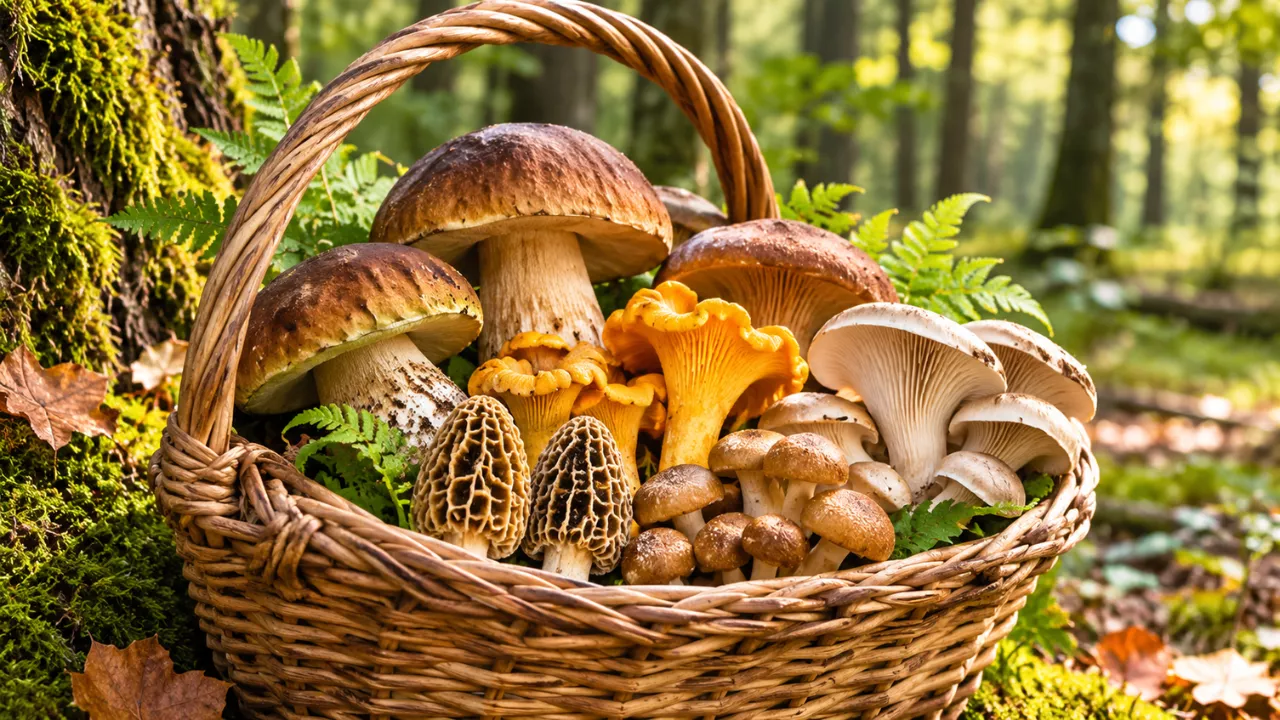
- Chanterelles: Orange-yellow mushrooms that often poke out of moss in woodland. They are prized by cooks.
- Porcini: Also called cep or penny bun, this is one of the most sought-after wild mushrooms in Europe.
- Parrot waxcap: A striking, slimy mushroom that can show green, yellow and pink tones. It fruits in autumn across northern Europe.
- St George’s mushroom: A spring species, named for appearing around St George’s Day on 23 April.
| Mushroom | Main Season | Where to Look | Notes |
|---|---|---|---|
| Chanterelle | Late summer to autumn | Woodland, often among moss | Popular edible; has lookalikes |
| Porcini (cep) | Late summer to autumn | Woodland floors | Highly prized edible |
| Parrot waxcap | Autumn | Grassland across northern Europe | Best admired, not picked |
| St George’s mushroom | Spring (around 23 April) | Grassy areas and woodland edges | Proof that spring is fruitful too |
How to Forage Wild Mushrooms Safely
Foraging can be a rewarding hobby when done responsibly. Even so, it carries real danger. Several deadly species closely resemble edible ones, and a mistake can be fatal.
Experts have also raised a newer concern. A wave of mushroom identification books written by generative AI has appeared, and some contain potentially deadly errors. Therefore, always rely on trusted guides, local foraging groups or experienced mycologists. Keep these rules in mind:
- Never eat a mushroom unless you are completely sure what it is.
- Use reputable field guides rather than unverified books or apps.
- Pick only what you need and leave plenty for wildlife.
- Check local rules, since some woodlands ban or limit picking.
Foragers often repeat an old warning: there are old mushroom hunters and bold mushroom hunters, but no old, bold ones. Put simply, never eat on a hunch.
How Climate Change Is Shifting the Mushroom Season
Fungi depend heavily on rain and temperature. Unsurprisingly, climate change is altering when mushrooms appear and how long the season lasts. This mirrors wider changes in nature, where some plants now flower earlier than they used to.
A longer season might sound like good news for foragers. On the other hand, shifting conditions bring problems too. For instance, valley fever, a lung infection caused by soil fungi in the south-western US, tends to peak in autumn and surge after wet winters. Similarly, more frequent flooding could increase exposure to mould inside homes.
Fungi Can Even Help Make Rain
Interestingly, fungi do not just enjoy rain. Their airborne spores can act as surfaces where moisture gathers into droplets. On a large scale, this process can contribute to cloud formation. It is one more reminder of how much fungi quietly shape the world around us.