 NK Mehta
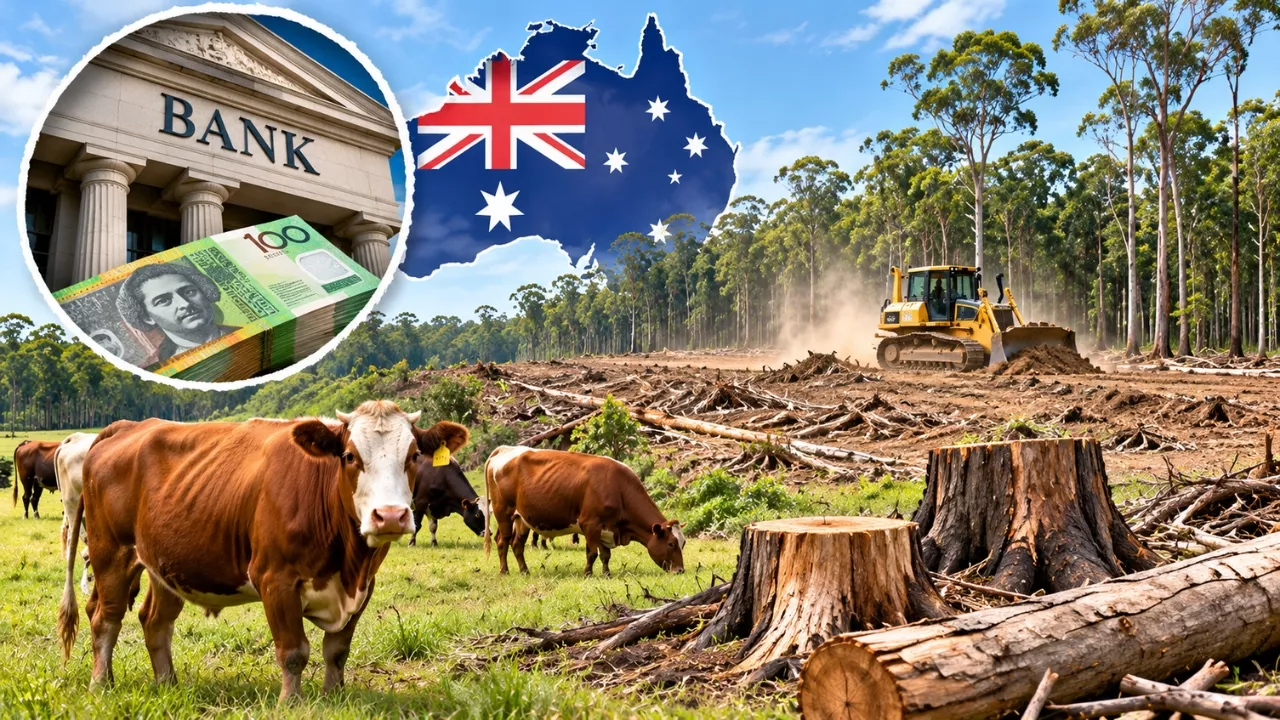
Australia rarely appears in global conversations about forest loss. Most people think of the Amazon or Southeast Asia first. However, a new investigation suggests Australian deforestation linked to beef farming deserves far more attention. It also points to a group few shoppers would expect: the country’s biggest banks.
The findings come from the Australian Conservation Foundation (ACF) and its September 2026 report, Bulldozers and Broken Promises. The report reviewed satellite imagery covering more than 10 million hectares. In the end, it identified 150 separate clearing cases across Australian properties. Together, these cases covered more than 32,000 hectares of native forest and woodland.
What the Investigation Found About Beef Farming
The headline figure is striking. Roughly 99% of the clearing identified was linked to agriculture. Most of it was cleared to create pasture for cattle grazing.
Queensland stands out once again. The state clears more forest than any other in Australia. It also has the largest cattle herd. According to the ACF, more forest is cleared in Queensland for beef than for palm oil in Indonesia. That comparison surprises many readers. Still, it reflects data from Queensland’s own Statewide Landcover and Trees Study (SLATS).
Some of the cases were found close to sensitive environments. For example, eleven cleared properties sat within catchments that drain into the Great Barrier Reef. On one property in the Hervey Range, west of Townsville, clearing was reportedly still underway in July 2026. Another example came from a beef property near Warwick in southern Queensland.
How Major Banks Are Connected to Land Clearing
This is the part of the report that sets it apart from earlier studies. Investigators matched property records with mortgage data. As a result, they linked 82 of the clearing cases to loans from major Australian banks.
Those 82 cases covered about 16,540 hectares, or around 40,900 acres. The banks named include NAB, Commonwealth Bank and ANZ. According to the report, no Australian bank currently has a policy requiring borrowers to avoid deforestation.
Why does this matter? Lending shapes how land is used. When banks finance properties without checking for clearing, they may indirectly support it. In contrast, clear lending rules could encourage farmers to expand without bulldozing native bushland.
Key Figures at a Glance
| Finding | Detail |
|---|---|
| Satellite area reviewed | More than 10 million hectares |
| Clearing cases detected | 150 |
| Total area cleared | Over 32,000 hectares |
| Share linked to agriculture | About 99%, mainly beef grazing |
| Cases linked to bank mortgages | 82 cases (about 16,540 hectares) |
| Banks named | NAB, Commonwealth Bank, ANZ |
| Cases in Great Barrier Reef catchments | 11 |
| Supermarket deforestation-free target | End of 2025 (not met) |
Why Supermarket Promises Matter for Shoppers
Coles and Woolworths both pledged to sell only deforestation-free beef by the end of 2025. However, both companies admitted in their 2026 sustainability reports that they had not put those targets into practice. Consequently, shoppers have no reliable way to know whether beef on the shelf comes from cleared land.
McDonald’s, the largest buyer of Australian beef, has its own commitment. Yet its deadline is not until 2030. Meanwhile, tracing beef back to individual properties remains difficult. Cattle often move between several farms before processing. That makes supply chains harder to track than many consumers realise.
Here is what this means for everyday buyers:
- Labels are limited: Most beef packaging does not show whether the farm cleared land.
- Pledges are not proof: A company target only helps once it is fully implemented and checked.
- Questions help: Asking retailers about property-level tracing puts pressure on the supply chain.
- Most farmers are not involved: The problem comes from a minority of producers, not the whole industry.
The Industry’s Side of the Story
It is important to be fair here. Many beef producers manage their land responsibly. Earlier research by the Wilderness Society found that around 68% of Queensland beef lots had no clearing over a five-year period. In other words, a smaller group of properties appears responsible for most large-scale clearing.
Industry bodies have also pushed back on some claims. Cattle Australia has argued that the country needs a clearer, agreed definition of deforestation. That debate matters, because regrowth forest and older woodland are often treated differently under state laws.
What Australian Deforestation Means for Wildlife and Trade
Native forests and woodlands provide homes for koalas, greater gliders, quolls and many birds. When large areas are cleared, habitats become fragmented. Therefore, animals lose food, shelter and safe routes between remaining patches of bush.
Runoff is another concern. Cleared land near the reef can increase sediment flowing into coastal waters. Over time, this can affect water quality and marine life.
Trade pressure is also growing. The European Union has introduced strict rules on products linked to deforestation. Similarly, other markets are watching supply chains more closely. Australian beef exporters may face tougher questions if clearing continues without clear tracking.
What Could Change Next
Several practical steps could reduce Australian deforestation tied to beef farming:
- Banks could adopt lending policies that screen for land clearing.
- Supermarkets could trace beef back to individual properties.
- State and federal governments could agree on a national definition of deforestation.
- Buyers could reward producers who keep native vegetation intact.
Ultimately, the investigation shows that clearing is not only a farming issue. It also involves lenders, retailers and policymakers. Fixing it will likely need all of them to act together.
Frequently Asked Questions
1. Is beef farming the main cause of deforestation in Australia?
Yes. In Queensland, which clears the most land in Australia, beef grazing is the leading driver of forest and woodland clearing.
2. Which banks were linked to the cleared properties?
The investigation named NAB, Commonwealth Bank and ANZ. It linked 82 clearing cases to mortgages from major Australian banks.
3. Did Coles and Woolworths meet their deforestation-free beef targets?
No. Both supermarkets set an end-of-2025 deadline but admitted in 2026 that they had not implemented those targets.
4. Are all Australian beef farmers clearing forests?
No. Most beef properties show no recent clearing. A minority of producers account for the bulk of large-scale deforestation.