 NK Mehta
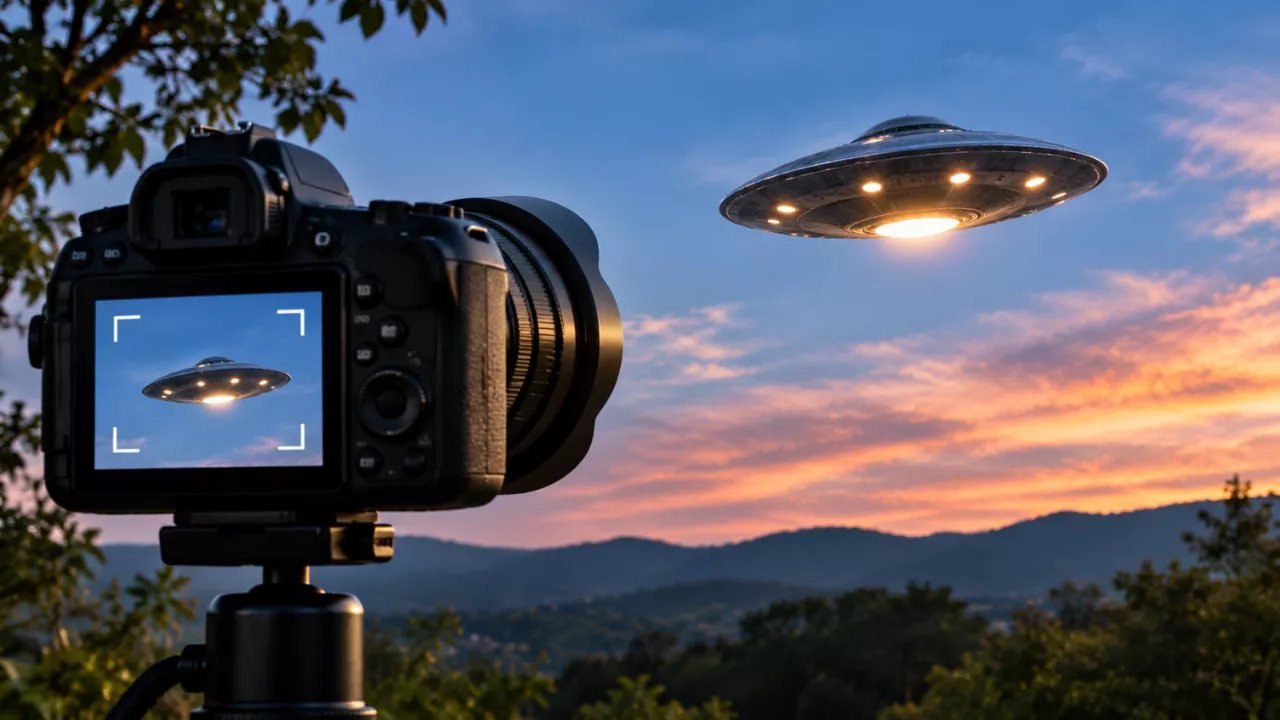
For almost eighty years, people have pointed cameras at the sky and come back with something strange. That makes UFO photo evidence a hard question. A picture feels like proof. However, anyone who has studied these images closely knows that a photograph raises as many questions as it answers. In this article, we look at why images carry so much weight in the UFO debate, why they so often fail, and what a strong piece of visual evidence would actually need.
Why Images Became the Heart of the UFO Debate
The modern UFO era began in 1947, when pilot Kenneth Arnold reported fast-moving objects near Mount Rainier. Soon after, the press coined the phrase “flying saucer.” From that moment, the public wanted pictures. Eyewitness stories were easy to doubt, but a photograph seemed to settle the matter.
The 1950 McMinnville photos from Oregon are a good example. They showed a disc-like shape above a farm and were printed in Life magazine. Even today, analysts argue over whether the object was a distant craft or a small model hung from wires. In that sense, the case shows the core problem well. An image records light, but it does not record scale, distance, or intent.
What Cameras Get Wrong About the Sky
The sky is one of the hardest things to photograph accurately. There are no reference points, so the eye can’t judge size or distance. As a result, ordinary objects can look extraordinary on camera.
Common causes of misleading UFO images include:
- Lens flares and reflections from windows, glasses, or bright lights
- Birds and insects blurred by motion close to the lens
- Balloons, sky lanterns, and drones, which drift or hover in odd ways
- Satellite trains, such as lines of Starlink satellites shortly after launch
- Planets and bright stars, especially Venus near the horizon
- Digital editing and AI-generated images, which are now easy to make
Smartphones add a further layer of confusion. Their software sharpens, merges, and adjusts images automatically, so a phone can create shapes that were never there.
How Official Investigators Judge UFO Photo Evidence
France has taken this subject seriously for decades. Since 1977, the national space agency CNES has run a dedicated unit, now called GEIPAN, to study reports of unidentified aerial phenomena. Its investigators sort each case into categories based on how well it can be explained.
| Category | Meaning | What It Says About the Image |
|---|---|---|
| A | Fully identified | The cause is clear, such as a plane, balloon, or planet |
| B | Probably identified | A likely explanation exists, but some doubt remains |
| C | Unidentified, too little data | The photo or report lacks the detail needed to decide |
| D | Unidentified after investigation | Good data, yet no known explanation fits |
Notably, the largest group of unresolved cases sits in category C. In other words, many “mysteries” stay open simply because the photo is blurry or missing key details. Only a small share of cases end up in category D. Even then, “unidentified” means unexplained, not alien.
Military Videos and the New Era of UFO Images
The debate changed in 2017, when the public first saw US Navy infrared videos of fast, oddly shaped objects. In 2020, the Pentagon officially released three of them. Consequently, the topic moved from fringe interest to congressional hearings.
The United States later created an office, AARO, to collect and review such reports. Meanwhile, a NASA study team published its findings in 2023. It found no evidence that these phenomena come from outside Earth. Nonetheless, it called for better data, more sensors, and less stigma for pilots who report what they see.
Similarly, independent analysts showed that some famous military clips may have simple causes. For instance, a rotating shape in one video may be the camera’s own glare. Another “fast” object may be moving slowly, with the speed an illusion created by the jet’s motion.
What Would Real Proof Look Like?
A single photo, however striking, will rarely be enough. Instead, investigators look for several kinds of data that support each other. Strong visual evidence would usually include:
- Original files with untouched metadata, including time, date, and location
- Multiple witnesses filming from different angles at the same moment
- Sensor data from radar, infrared, or other instruments
- Known reference points in the frame, such as buildings or trees
- A full chain of custody, showing the file was not altered
Ultimately, the camera is a witness, and like any witness it can be wrong. That is why careful researchers treat a UFO image as the start of an inquiry rather than its conclusion.
Why the Question Still Fascinates Us
There is something human in this search. We want to believe our eyes, and we want the sky to keep some secrets. At the same time, the rise of AI-generated pictures makes trust harder than ever. Going forward, the value of UFO photo evidence will depend less on how dramatic an image looks and more on how well it holds up under testing.
As a result, the most useful mindset is open curiosity combined with healthy doubt. Look closely, ask questions, and remember that “I don’t know” is often the most honest answer.
Frequently Asked Questions
Has any photo ever proven that UFOs are alien spacecraft?
No. Some images remain unexplained, but none has been confirmed as an alien craft by scientists or official investigators.
Why are so many UFO photos blurry?
Objects in the sky are often far away, moving, or seen at night. Also, phone cameras struggle in low light and with distant subjects.
What is GEIPAN?
It is a unit of the French space agency CNES that has investigated reports of unidentified aerial phenomena since 1977.
How can I tell if a UFO photo is fake?
Check for original metadata, other witnesses, and known objects in the frame. Furthermore, consider simple causes like drones, satellites, or lens reflections first.