 NK Mehta
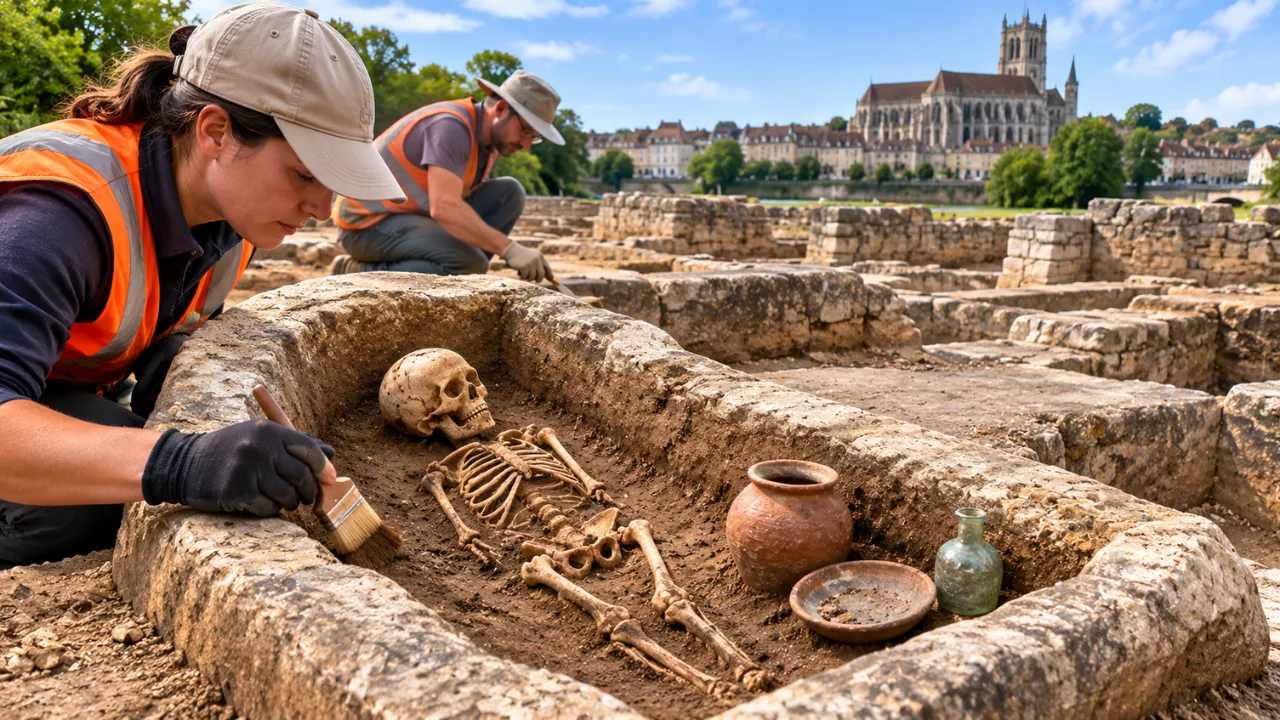
Beneath a busy town square in Burgundy, archaeologists have found something deeply moving. The Gallo-Roman infant necropolis in Auxerre holds the remains of around 260 babies and foetuses. They were buried with care nearly 1,800 years ago. Moreover, the site is being described as unique in the Roman world. Its results, presented on 3 November 2026, offer a rare and tender look at how ancient families mourned their youngest children.
Where the Auxerre Infant Necropolis Was Found
The discovery came from a preventive excavation, not a planned research dig. In fact, the city was redesigning Place du Maréchal-Leclerc, a square near the Clock Tower and the Town Hall, to add more greenery. Before the work began, archaeologists from France’s national preventive archaeology institute, Inrap, were called in. They excavated the site between February and June 2024.
At first, the team was focused on the remains of a 4th-century fortified enclosure. This wall marked the rebirth of Roman Autessiodurum, the ancient name of Auxerre. However, the fortification turned out to sit on top of an older cemetery. That burial ground dated to the early Roman Empire and had never been recorded before.
Key Facts About the Discovery
The table below sums up the main details of the find.
| Detail | Information |
|---|---|
| Location | Place du Maréchal-Leclerc, central Auxerre (Yonne, France) |
| Excavated by | Inrap, under the regional cultural affairs office (DRAC) |
| Dig period | February to June 2024 |
| Results presented | 3 November 2026 |
| Number of burials | Around 260 |
| Area | Only about 45 square metres |
| Date of graves | Mainly 2nd–3rd centuries AD (within the 1st–3rd century cemetery) |
| Who was buried | Foetuses, stillborn babies and very young infants |
How Gallo-Roman Families Buried Their Babies
What stands out most is the care shown to each child. Some babies were swaddled before burial. Others were placed in ceramic pots, laid on roof tiles or set inside wooden coffins. In addition, flowers were left in certain graves. As a result, the site shows a wide range of burial practices within one small space.
Families also left small objects meant to protect the children in the afterlife. These included:
- A bead
- A coin
- A spindle
- A miniature ceramic cup placed near one child’s head
Archaeologists call such items protective, or “apotropaic,” objects. Taken together, they suggest that these infants were mourned and guarded, not simply set aside.
Ancient DNA in “Empty” Pots
One finding is especially striking. Some ceramic vessels looked empty at first. Yet lab tests detected ancient human DNA inside them. Therefore, researchers think these pots may have held babies born very prematurely, or even tissue such as the placenta. This shows how modern science can recover traces that the eye cannot see.
Why the Auxerre Discovery Challenges Old Beliefs
For a long time, historians assumed that very young babies were treated differently from older children and adults in Roman society. Ancient writers suggested that infants who died early were not given full funerals. Instead, they were thought to be buried quietly near homes rather than in proper cemeteries.
The Auxerre infant necropolis tells a different story. Here, tiny children received their own dedicated burial ground, with thoughtful and sometimes elaborate graves. Even so, experts note that the small space and dense layout may reflect limited room, or the special status of newborns. According to Inrap archaeo-anthropologist Carole Fossurier, the find was unexpected, since Auxerre was barely known for its Gallo-Roman past, let alone its cemeteries.
What This Find Means for Roman Archaeology
Infant deaths were very common in the ancient world. Consequently, cemeteries of the time often had small zones set aside for babies at their edges. Still, a site holding so many infant graves in such a small area is extremely rare. Similar recent work, such as excavations in Narbonne, is also raising new questions about how Romans cared for their youngest dead.
Above all, the discovery adds an emotional layer to history. It reminds us that grief for a lost child is not a modern feeling. Rather, it is something people in Roman Gaul clearly shared.
FAQs
What was found in Auxerre?
Archaeologists found a Gallo-Roman cemetery with about 260 burials of foetuses, stillborn babies and very young infants.
How old is the Auxerre infant necropolis?
Most graves date to the 2nd and 3rd centuries AD, roughly 1,800 years ago.
Why is this discovery important?
It shows that Roman-era families gave infants careful, dedicated burials, which challenges the idea that newborns were not fully mourned.
Who excavated the site?
The dig was carried out by Inrap, France’s national institute for preventive archaeological research, before the square was redeveloped.