 NK Mehta
In September 2023, seismologists noticed something they could not explain. Sensors from the Arctic to Antarctica picked up a faint, steady pulse. It repeated roughly every 90 seconds, and it did not stop for nine days. This Greenland fjord seismic signal looked nothing like an earthquake. As a result, many experts first labelled it an “unidentified seismic object.”
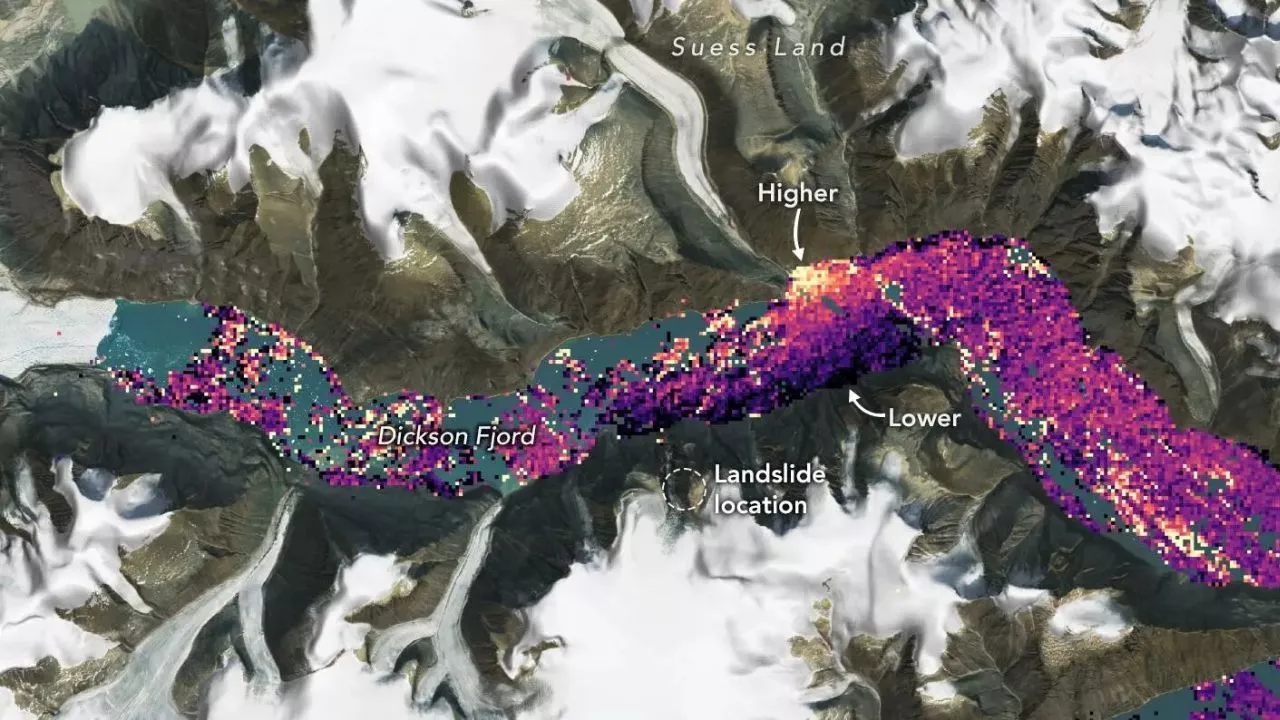
The answer was eventually found in Dickson Fjord, a narrow and remote inlet in East Greenland. What happened there combines a collapsing mountain, a giant wave and a warming climate. Moreover, it shows how events in isolated corners of the planet can be felt everywhere.
What Made This Seismic Signal So Unusual?
Most earthquakes produce a messy burst of vibrations that fades within minutes. This signal was different. Instead, it was a clean, single-frequency tone of about 10.88 millihertz. One of the lead researchers compared it to pressing a single piano key and holding it for over a week.
Even stranger, a similar signal appeared again about a month later, in October 2023. Because there was no earthquake, volcano or explosion to blame, the puzzle drew in dozens of scientists from many countries.
How a Landslide in Dickson Fjord Started It All
The trail led to a steep mountain that once rose about 1.2 kilometres above Dickson Fjord. On 16 September 2023, its peak gave way. Roughly 25 million cubic metres of rock and ice crashed into the water below.
That impact launched a mega-tsunami estimated at around 200 metres high near the slide. Satellite images later showed a dust cloud in the gorge. In addition, before-and-after photos confirmed that a large part of the mountain and its glacier had vanished.
The Key Facts at a Glance
| Detail | What Scientists Found |
|---|---|
| Location | Dickson Fjord, East Greenland |
| Date of first event | 16 September 2023 |
| Rock and ice volume | About 25 million cubic metres |
| Initial tsunami height | Around 200 metres near the slide |
| Height of sloshing wave (seiche) | About 7 metres |
| Signal period | Roughly 90–92 seconds |
| Signal frequency | 10.88 millihertz |
| Duration | About nine days |
| Main trigger | Glacier thinning linked to warming |
Why the Water Kept Sloshing: Understanding the Seiche
A normal tsunami spreads outward and loses energy. However, Dickson Fjord is long, narrow and has steep parallel walls. As a result, the wave became trapped and began to rock from side to side.
This back-and-forth motion is called a seiche. Think of water sloshing in a bathtub after you sit down quickly. In the fjord, the sloshing wave settled at around 7 metres high. Each swing took about 90 seconds, which matched the seismic rhythm exactly.
Every time the water pushed against the fjord walls, it nudged the Earth’s crust slightly. Consequently, those repeated pushes travelled through the planet as seismic waves. That is why stations thousands of kilometres away could record them.
Here is why this discovery stood out to researchers:
- It was the first landslide and tsunami ever recorded in eastern Greenland.
- No one had directly recorded water sloshing for days from a single short event.
- The seiche kept going without help from storms or strong winds.
- A Danish naval vessel passed through days later and saw nothing unusual on the surface.
How Scientists Finally Solved the Puzzle
Cracking the case took teamwork across seismology, geology, oceanography and satellite science. First, researchers used seismic data to pinpoint the source. Next, they compared satellite imagery and field photos to confirm the landslide.
After that, they built detailed computer models of the fjord using declassified seabed mapping. These simulations showed water swinging back and forth at almost the same frequency as the signal. Later work used a new satellite designed to map surface water heights. It measured the slope of the water across the fjord and gave direct evidence that the seiche had really happened.
What This Means for Climate Change and Arctic Safety
Scientists linked the collapse to thinning of the glacier at the base of the mountain. For decades, that ice had helped hold the slope in place. As it melted, the rock lost its support and finally failed.
This matters well beyond Greenland. Warming temperatures are making steep polar slopes less stable. Furthermore, landslides that fall into narrow fjords can create especially powerful waves.
Dickson Fjord also sits on a route used by tourist cruise ships. Fortunately, no vessels were nearby on the day of the collapse. Even so, the event is a clear warning. Better monitoring of unstable slopes in the Arctic could help protect visitors, researchers and local communities in the years ahead.
Frequently Asked Questions
What caused the 90-second seismic signal in 2023?
A huge landslide of rock and ice fell into Dickson Fjord in East Greenland. It triggered a tsunami that became trapped and sloshed back and forth every 90 seconds, shaking the Earth.
What is a seiche?
A seiche is a standing wave in an enclosed or semi-enclosed body of water. The water rocks back and forth, much like water sloshing in a bathtub.
Was anyone hurt by the Greenland tsunami?
No injuries were reported. The fjord is very remote, and no cruise ships were close by when the landslide happened.
Is climate change linked to the Dickson Fjord landslide?
Yes. Researchers found that a thinning glacier at the base of the mountain weakened the slope, which led to the collapse.