 NK Mehta
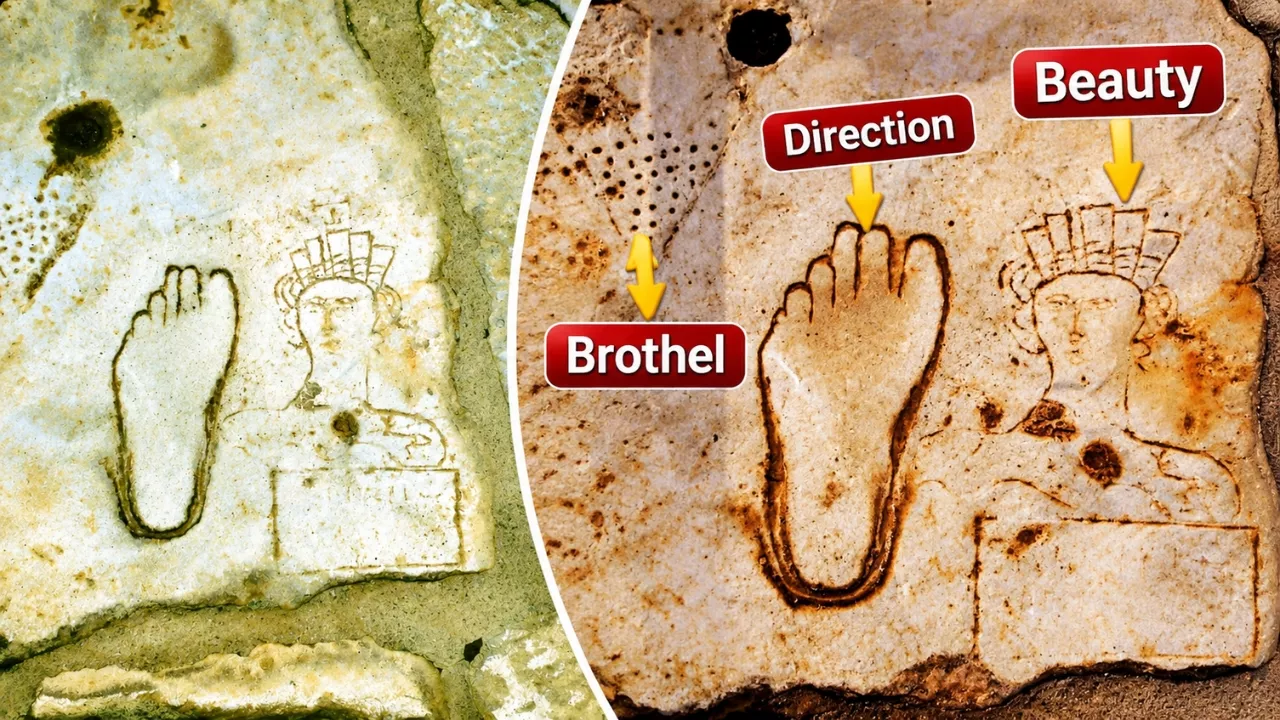
Most visitors to Ephesus look up. They gaze at the towering facade of the Library of Celsus and the columns lining Curetes Street. However, one of the most talked-about relics in the ancient city sits right at their feet. It is the Ephesus brothel sign, a small set of carvings cut into a paving slab on Marble Street.
Local guides often call it the oldest advertisement in the world. In fact, the carvings are usually said to point the way to a nearby “house of love.” Whether or not that claim holds up, the stone offers a rare glimpse of everyday life in a busy Roman port. It also shows how ordinary people may have left messages for one another nearly two thousand years ago.
Where to Find the Brothel Sign in Ephesus
The carving lies on Marble Street, the paved avenue that runs from the Library of Celsus toward the Great Theatre. Specifically, it sits close to the point where Marble Street meets Curetes Street, just across from the library. Because the slab is part of the walking surface, many visitors stroll over it without noticing.
Today, the stone is usually protected by a low barrier so that foot traffic does not wear it away further. Even so, the marks are shallow and weathered. As a result, they are easiest to see in soft morning or late afternoon light, when shadows fill the grooves.
What the Symbols on the Ephesus Brothel Sign Mean
The slab carries a handful of simple images. None of them comes with written words, so every reading is an interpretation. Still, guides and writers have settled on a fairly consistent explanation, summed up in the table below.
| Symbol | Popular interpretation | How certain is it? |
|---|---|---|
| Left footprint | Shows the direction to walk, toward the building said to be the brothel | Widely accepted as a pointer |
| Woman’s head or portrait | Suggests a woman, or women, waiting at the destination | Commonly repeated, but debated |
| Heart-like shape | Hints at love or romance | Uncertain; the shape is worn and unclear |
| Rectangle or square with holes | Often read as a coin purse, a payment hint, or even the library opposite | Highly speculative |
Taken together, these marks are read as a short visual message: walk this way, and you will find a woman for a price. Notably, a picture-based sign made sense in a cosmopolitan harbour city. Sailors, traders and travellers from across the Mediterranean spoke many languages, yet anyone could follow a footprint.
- No text: the sign relies entirely on images.
- Placement: it is set into the road, not on a wall.
- Condition: centuries of footsteps have softened the edges.
The Foot-Size Legend: Fact or Folklore?
One story comes up on almost every guided tour. According to local lore, the footprint is roughly a modern size 39. Visitors are told that anyone whose foot was smaller was considered too young to enter.
It is a memorable tale, but it has no firm historical support. Roman measurement did not use modern shoe sizes, and no ancient source describes such a rule. Moreover, the footprint is more naturally explained as a simple arrow. Therefore, it is best treated as tour-guide folklore rather than established fact.
Was There Really a Brothel in Ephesus?
The popular story links the sign to a building near the Marble Street and Curetes Street junction, often labelled the brothel or house of love. Early excavators identified it that way, and the name has stuck with guidebooks ever since.
On the other hand, some archaeologists are more cautious. They point out that the evidence for a brothel at that spot is limited. Some argue the building may have been a private house or part of a larger complex instead. Likewise, the carving itself may have had a different purpose that is now lost.
In short, the brothel reading is plausible but not proven. That uncertainty does not make the stone any less interesting. If anything, it is a useful reminder that much of what we “know” about ancient sites is careful guesswork.
Tips for Spotting the Sign on Your Ephesus Visit
Ephesus lies near the town of Selçuk in western Turkey, and it is a UNESCO World Heritage Site. The ruins are large, so it helps to plan your route. Once you reach the Library of Celsus, the sign is only a few steps away.
- Ask your guide: most licensed guides stop at the sign and will point it out.
- Look down near the library: scan the paving on Marble Street, close to the corner with Curetes Street.
- Go early or late: low sunlight makes the shallow carvings far easier to read and photograph.
- Respect the barrier: stay off the slab so the marks survive for future visitors.
Afterwards, take a moment to look back along the street. Picture it filled with merchants, sailors and city officials. Suddenly, a worn footprint in the stone feels like a message from a crowded, noisy world that once shared this very road.
FAQs About the Ephesus Brothel Sign
Is the Ephesus brothel sign really the oldest advertisement in the world?
It is often described that way, but the claim is popular rather than proven. Other ancient cultures also used painted and carved signs to promote trades and services.
Where exactly is the brothel sign in Ephesus?
It is carved into a paving stone on Marble Street, near its junction with Curetes Street and opposite the Library of Celsus.
What does the footprint on the sign mean?
Most experts read it as a direction marker showing which way to walk. The idea that it checked a visitor’s age by foot size is folklore.
Can visitors still see the sign today?
Yes. The sign remains in place within the archaeological site, usually behind a small protective barrier.