 NK Mehta
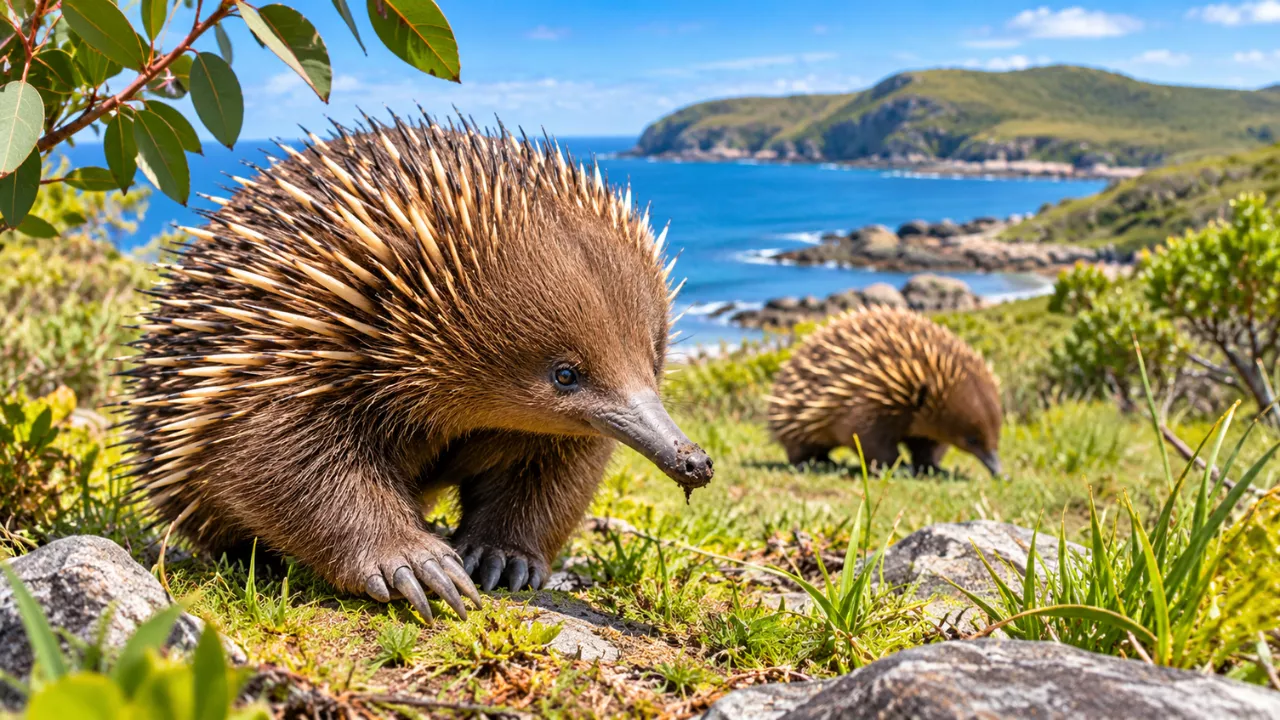
For two years, conservationists worried that a single echidna was wandering a fire-scarred island by itself. Now, fresh trail camera footage and a surprise encounter in a cat trap suggest that Australia’s loneliest echidna has plenty of company. The discovery on Lungtalanana, also known as Clarke Island, is being hailed as a sign that the land is slowly healing.
A Surprise Discovery in a Feral Cat Trap
In September, Pakana ranger Tasha Cooper was learning how to trap feral cats on the island. Instead of a cat, however, she found an echidna curled up inside the cage. In palawa kani, the language of Tasmania’s Aboriginal people, the animal is called trimanya.
The moment was significant because nobody had seen an echidna in person on the island for decades. Cooper later described feeling so overwhelmed that she didn’t know whether to cry or scream. Until then, every recent sighting had come only from remote cameras.
How Australia’s Loneliest Echidna Got Its Name
The story began in 2023, when a trail camera captured two images of an echidna, taken months apart. Because rangers had thousands of photos to review, those images were not spotted until 2024. Even so, the find was remarkable.
Many had feared the species was wiped out on the island. In 2014, a bushfire burned through 98 per cent of Lungtalanana’s vegetation. As a result, WWF Australia, which supports the island’s Aboriginal-led restoration work, nicknamed the animal “Australia’s loneliest echidna.”
More Cameras, More Echidnas
After that first sighting, rangers expanded their camera network. Consequently, another echidna was recorded in 2025, followed by three more images this year. Echidnas have now been detected at four separate locations across the island.
How Many Echidnas Live on Clarke Island?
To work out whether the cameras were catching one busy animal or several, rangers turned to University of Tasmania echidna expert Professor Stewart Nicol. He explained that echidnas are secretive, so counting them is difficult without tracking.
Still, his estimate was encouraging. Given the island’s size and the number of sightings, he said he would be surprised to find fewer than a dozen. In fact, he suggested there could be 20 to 30 echidnas, or possibly more.
| Year | Event on Lungtalanana/Clarke Island |
|---|---|
| 2005 | Island returned to Aboriginal ownership |
| 2014 | Bushfire destroys 98% of the island’s vegetation |
| 2023 | Trail camera captures two echidna images |
| 2024 | Images discovered during photo review |
| 2025 | Another echidna recorded on camera |
| 2026 | Three more camera sightings and first in-person encounter |
About Lungtalanana/Clarke Island
Lungtalanana sits in the Furneaux Group, off Tasmania’s north-east coast in Bass Strait. Covering about 8,230 hectares, the island was handed back to Aboriginal ownership in 2005. Since then, Pakana rangers have cared for it using a mix of traditional and modern methods.
Their work includes:
- Weed removal to give native plants room to recover
- Cultural burning to manage fuel loads and support healthy country
- Remote wildlife monitoring using trail cameras
- Feral cat control to protect small native animals
The Lungtalanana Restoration Project
Meanwhile, the timing of the echidna news is fitting. Last month, the Tasmanian Aboriginal Centre launched the Lungtalanana Restoration Project. Its goal is to return the island as closely as possible to its pre-colonial state.
Beyond removing invasive species, the project aims to repair habitat and bring back animals that have disappeared locally. These include Bass Strait wombats, Bennett’s wallabies and long-nosed potoroos. Altogether, organisers hope to re-establish at least six species lost to predators, land clearing and severe bushfires.
The project will also create training and jobs for Palawa people. In addition, it is designed to strengthen culture and connection to country.
Why Feral Cats Come First
Healthy Country ranger Tooarn Brown said removing feral cats is the top priority. Rangers want them gone before any major rehabilitation begins. He added that confirming an echidna population shows their management is working. In his view, native planting and predator control are combining to create a safer environment where small animals no longer need to hide.
Why This Discovery Matters
Ultimately, the echidna sightings offer more than a feel-good headline. They show that wildlife can bounce back after catastrophic fire when habitat and predators are managed carefully. Moreover, they highlight the value of Aboriginal-led land care. For the Palawa community, as Cooper put it, the restoration is set to be a huge win.