 NK Mehta
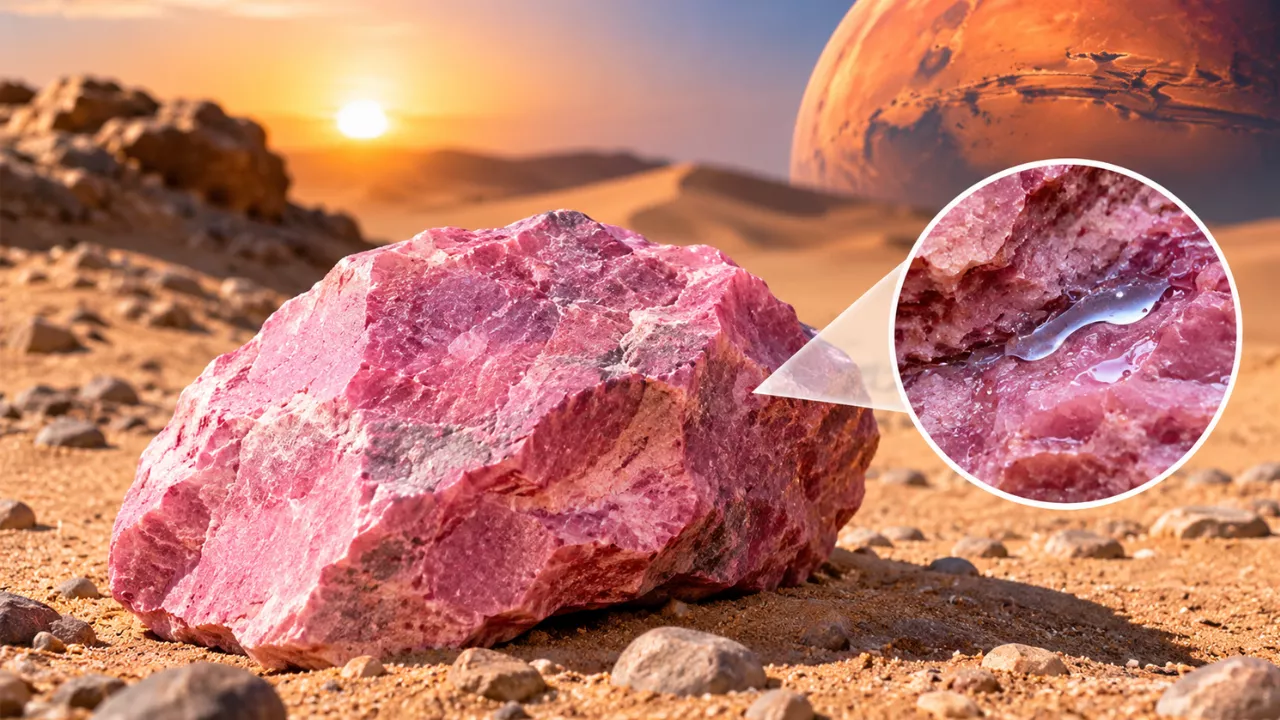
In 2022, desert searchers in Mali picked up an unusual pinkish stone from a dry salt plain. It looked striking, but nobody knew its full story at the time. Now, NASA-funded scientists have confirmed that the rock is a 4.1 billion-year-old Mars meteorite. Even more exciting, it carries chemical traces of water that once moved through the Red Planet’s crust.
The meteorite, named Teghaza 001, weighs about 800 grams. That is close to two pounds. Researchers say it ranks among the three oldest Martian rocks ever found on Earth. As a result, it offers a rare look at Mars during its earliest chapter, when the planet was likely warmer and wetter than it is today.
How the Mars Meteorite Was Found in the Sahara Desert
Sahrawi meteorite hunters recovered the stone in September 2022. These nomadic searchers comb North Africa’s deserts and have supplied many important finds over the years. The rock turned up on a salt plain in Mali, and scientists later named it after that location.
The Sahara is one of the best places on Earth to find meteorites. Its dry air slows weathering, and dark or colourful space rocks stand out against pale sand. However, nobody knows exactly when Teghaza 001 landed. It may have rested in the desert for thousands of years before anyone noticed it.
So how did a piece of Mars end up in Africa? A powerful impact on Mars blasted the rock into space. It then drifted through the solar system until its path crossed Earth’s orbit. Finally, it survived the fiery fall through our atmosphere and came to rest in the Sahara.
Why Teghaza 001 Stands Out Among Martian Meteorites
Scientists know of roughly 435 meteorites from Mars. Yet only three of them date back to the planet’s early history. Teghaza 001 now joins that small group, alongside ALH84001, found in Antarctica in 1984, and the well-known rock nicknamed “Black Beauty.”
What makes this find special is its makeup. Teghaza 001 is a gabbro, a coarse-grained rock that formed as magma cooled slowly underground. It also contains a mix of volcanic minerals, including tiny zircon crystals. In contrast, ALH84001 is made almost entirely of a single mineral, which limits what it can reveal.
Key features of the meteorite include:
- Age: At least 4.1 billion years old, and possibly older
- Rock type: Gabbro, formed below the Martian surface
- Minerals: A varied volcanic mix, including zircon
- Origin: Likely the southern highlands of Mars
- Colour: A distinctive rose or pinkish tone
Notably, the mineral mix matches rocks seen from orbit by NASA’s Mars Reconnaissance Orbiter in the southern highlands. Scientists say this is the first sample they have from that part of Mars. One reviewer of the research even described the rock as a kind of Rosetta Stone for the planet.
Quick Facts About the 4.1 Billion-Year-Old Mars Meteorite
| Detail | Information |
|---|---|
| Name | Teghaza 001 |
| Weight | About 800 grams (nearly 2 pounds) |
| Discovered | September 2022 |
| Location | Salt plain in the Sahara Desert, Mali |
| Found by | Sahrawi meteorite hunters |
| Age | At least 4.1 billion years |
| Rock type | Gabbro (coarse-grained igneous rock) |
| Possible source region | Southern highlands of Mars |
| Lead researcher | Yang Liu, NASA’s Jet Propulsion Laboratory |
| Published in | Science, with a companion study in Science Advances |
What the Meteorite Reveals About Water on Ancient Mars
Today, Mars is cold, dry and dusty. Still, scientists have long believed it once had rivers, lakes and possibly an ocean. Teghaza 001 adds strong new support to that idea.
The evidence lies in the rock’s isotopes. These are different forms of the same element. Hydrogen isotopes inside phosphate minerals, along with oxygen isotopes in the rock, point to contact with water. In other words, water seeped down into the deep crust and mixed with molten rock rising from the mantle. This is similar to processes that happen on Earth.
Lead author Yang Liu of NASA’s Jet Propulsion Laboratory described the meteorite as a witness to a wetter time on Mars. Meanwhile, a second study focused on the rock’s water content. It explored how water may have helped shape the planet’s early landscape.
What This Means for the Search for Life on Mars
Water is a key ingredient for life as we know it. Therefore, any proof that Mars once held water raises an important question. Could the planet have supported life in its distant past?
The findings suggest that early Mars, with a thicker atmosphere and flowing water, may have offered habitable conditions. However, those conditions seem to have faded quickly during the planet’s first billion years or so. Eventually, Mars lost much of its atmosphere and turned into the frozen world we see today.
Why Martian Meteorites Matter for Space Science
Rovers and orbiters have taught us a great deal about Mars. Even so, they cannot do everything a modern lab can. Meteorites like Teghaza 001 let scientists run detailed tests on real Martian rock here on Earth.
Furthermore, these samples help confirm what spacecraft observe from above. When a meteorite’s chemistry matches orbital data, researchers gain more confidence in their maps of Mars. For this reason, scientists expect further studies on Teghaza 001 in the years ahead.
Frequently Asked Questions
1. What is Teghaza 001?
Teghaza 001 is a pinkish, 800-gram meteorite from Mars. It was found in Mali’s Sahara Desert in 2022 and is at least 4.1 billion years old.
2. How do scientists know the meteorite came from Mars?
Its chemistry and mineral mix match known Martian rocks. In addition, its composition lines up with orbital observations of the southern highlands of Mars.
3. Does the meteorite prove there was water on Mars?
It provides strong evidence. Hydrogen and oxygen isotopes show the rock interacted with water in the Martian crust more than 4.1 billion years ago.
4. Is Teghaza 001 the oldest Mars meteorite ever found?
It is one of the three oldest known Martian meteorites. The other two are ALH84001 and the meteorite nicknamed “Black Beauty.”