 NK Mehta
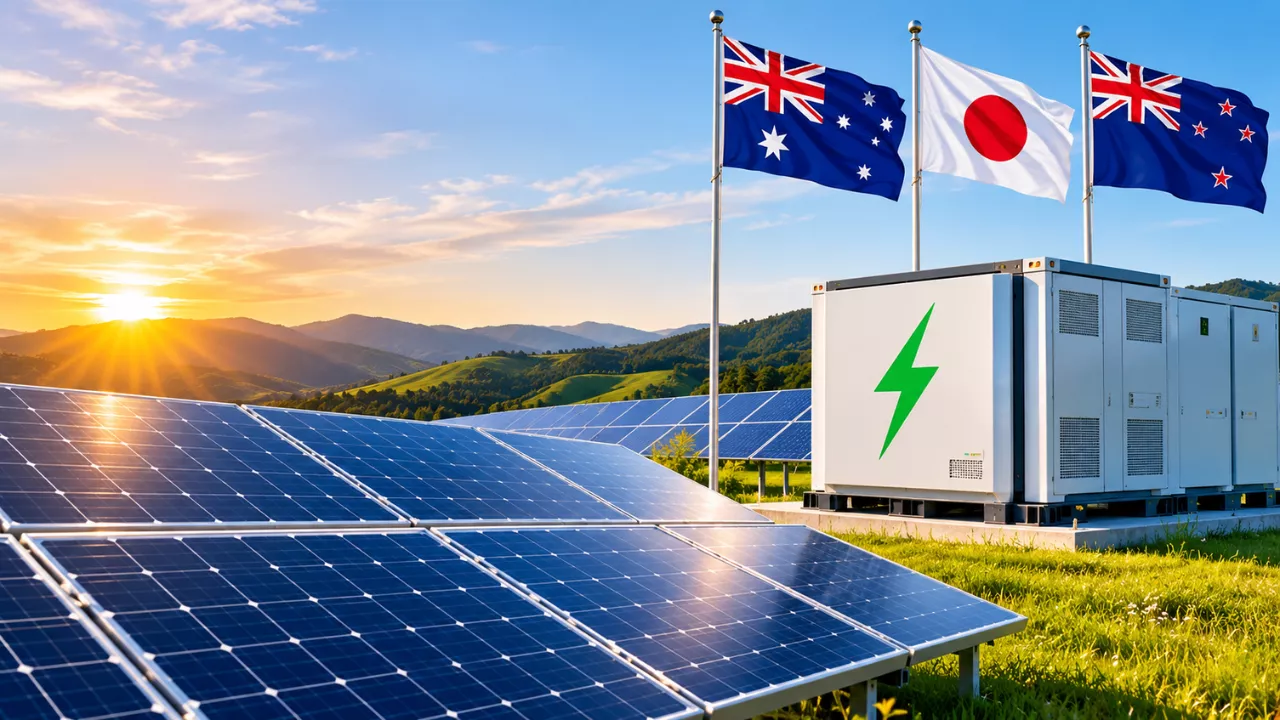
New Zealand’s renewable energy sector has received a major vote of confidence. Lightyears, a locally owned solar and battery developer, has secured a $NZ174 million (about $A139 million) finance package from Japanese and Australian investors. The money will help the company build a pipeline of 28 solar and battery projects over the next five years.
For a country that relies heavily on hydro, the deal matters. It shows that overseas capital now sees smaller, battery-backed solar farms in New Zealand as a sound long-term bet.
How the $NZ174 Million Lightyears Deal Is Structured
The package combines equity and debt from two different partners. Japan’s Obayashi Corporation is providing $NZ74 million in equity. Meanwhile, Australian lender Infradebt is supplying the remaining $NZ100 million as a loan.
Infradebt is not new to Lightyears. Last year, it refinanced the company’s portfolio, which then totalled 27 megawatts (MW). This new loan, therefore, deepens an existing relationship rather than starting a fresh one.
Obayashi’s role works a little differently. The Tokyo-listed construction group will hold a 90 per cent stake in a new solar holding company called LYOC1. Instead of handing over the full sum at once, it will invest in stages as each project hits agreed development milestones.
| Detail | Information |
|---|---|
| Developer | Lightyears (New Zealand-owned) |
| Total funding | $NZ174 million (≈ $A139 million) |
| Equity partner | Obayashi Corporation (Japan) – $NZ74 million |
| Debt partner | Infradebt (Australia) – $NZ100 million loan |
| New holding company | LYOC1 (90% owned by Obayashi) |
| Operating capacity | 30.7 MW across seven projects |
| Under construction | Roughly 35 MW |
| Development pipeline | 28 projects totalling 338 MW |
| Delivery timeframe | Next five years |
What Lightyears Solar and Battery Projects Look Like
Lightyears focuses on small-scale solar paired with battery storage. This approach differs from the giant utility farms that often grab headlines. Its seven operating sites range from 1 MW to 7 MW in size. Together, they generate 30.7 MW of renewable electricity.
One example is the Carterton 1 solar farm, which uses rows of tracking panels that follow the sun across the sky. Projects like this connect to local distribution networks, so the power is used closer to where it is generated.
The company’s growth plans are significant:
- About 35 MW of new capacity is currently under construction
- 28 upcoming projects are slightly larger than its existing sites
- 338 MW is the combined size of the development pipeline
In other words, Lightyears aims to grow its footprint roughly tenfold if the full pipeline is delivered.
Why Japanese and Australian Investors Are Backing New Zealand
Both investors have clear reasons for stepping in. For Obayashi, New Zealand is a priority market alongside Japan itself. The staged investment model also limits risk, because capital flows only as projects progress.
Infradebt, on the other hand, brings deep experience in this exact niche. Its co-founder, Chin-Lee Yu, described New Zealand as a market the firm likes. Over the past 13 years, the lender has backed more than 40 distribution-connected renewable projects. It is also the channel for a $100 million Clean Energy Finance Corporation package, announced in August, that supports 16 small-scale solar battery hybrid projects in Australia.
As a result, Lightyears gains more than money. It also gains partners who already understand how small hybrid projects are built and financed.
What the Funding Means for Lightyears
Managing director Matt Shanks says the capital gives the company a clear runway to deliver projects across the country. Just as importantly, it allows Lightyears to work on more projects at the same time rather than one after another.
Shanks also believes the expansion will support the wider renewable sector. He expects it to help lower energy prices for New Zealand households and businesses over time.
Māori Partnerships Are Shaping Local Ownership
Lightyears is not relying only on overseas money. The developer is also creating ways for local investors to share in renewable energy. Notably, eight Māori investor groups have helped fund the 15 MW Te Aho o te Rā solar project. This site sits next to Lake Taupō in the centre of the North Island.
This model is gaining ground across the industry. For instance, Mint Renewables, co-created by New Zealand infrastructure investor Infratil, signed a strategic partnership last year with South Island iwi Ngāi Tahu to develop utility-scale renewable projects.
These partnerships give communities a direct stake in local energy. They also help developers build trust and long-term support for new projects.
What This Means for New Zealand’s Energy Future
This deal highlights a clear shift in the market. Smaller solar-plus-battery projects are attracting serious institutional capital, not just large utility schemes. Batteries matter here because they store daytime solar power and release it when demand rises in the evening.
Furthermore, combining foreign investment with local and Māori ownership creates a balanced model. It brings in the capital needed to build quickly while keeping a meaningful share of the benefits within New Zealand. If Lightyears delivers its 338 MW pipeline, it could become one of the country’s more notable distributed solar and battery operators.