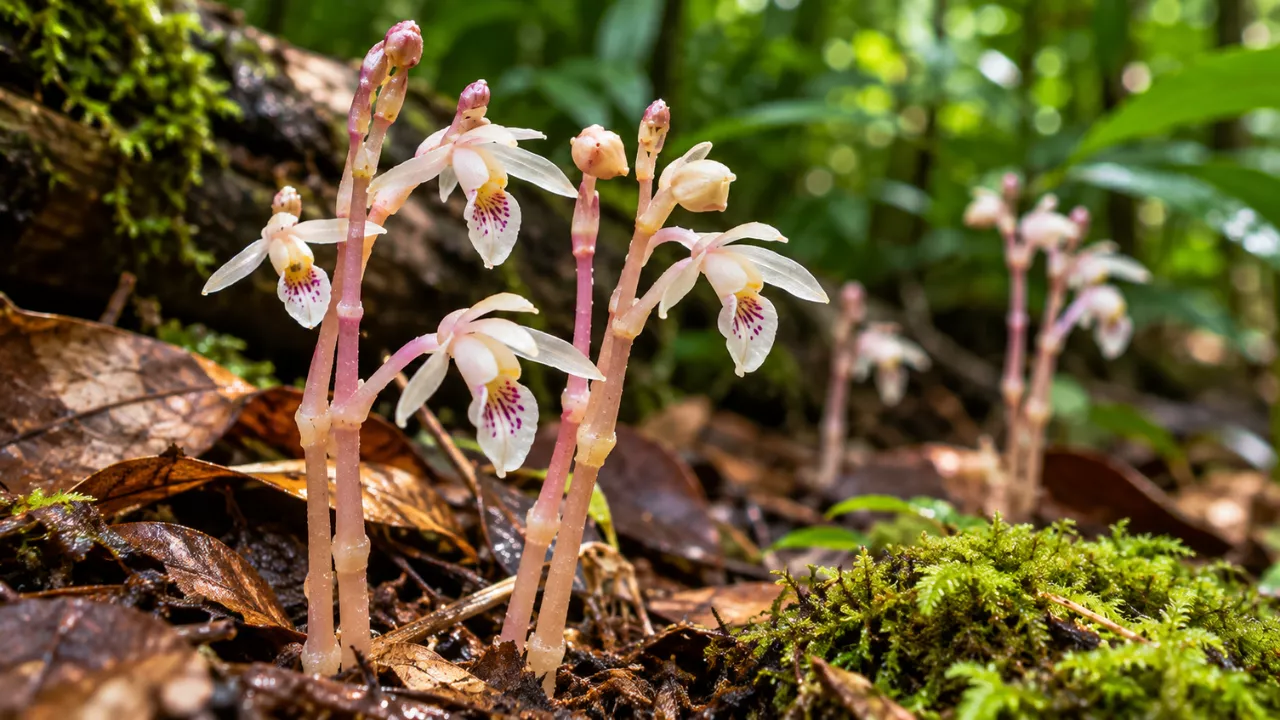
 NK Mehta
For years, the Bonville leafless orchid was known from just one patch of rainforest on the NSW Mid North Coast. That changed in late October 2026. A local teacher went looking for more and found a thriving new cluster near Boambee, about 5 kilometres from the original site. The plant grows nowhere else on Earth, so the find has given conservationists real cause for hope.
A Chance Search That Paid Off
Nick Lambert is a teacher with a passion for botany. On 22 October, he joined his friend Dr Lachlan Copeland to see the orchids in flower at their only known site. The visit stayed with him. The following day, he set out alone to explore other rainforest pockets in the area.
His instinct proved right. In a rainforest in the foothills near Boambee, he found around 50 plants. Dr Copeland inspected the site the next day and confirmed the discovery. Notably, he had shown the original site to about 30 botanists over the years. None of them had managed to find the orchid anywhere else, which makes Lambert’s success even more remarkable.
What Makes the Bonville Leafless Orchid So Unusual
The orchid’s scientific name is Danhatchia copelandii. It honours Dr Copeland, who first found the species on the property where he lived in 2018. Unlike most plants, it has no leaves at all. As a result, it cannot photosynthesise.
Instead, the orchid depends entirely on a fungus living in the soil around its roots. This fungus supplies all of its nutrients. For most of the year, the plant stays hidden underground. It only appears above the leaf litter to flower, usually for just one or two weeks.
Key traits of the species include:
- Height: roughly 10 centimetres tall
- Appearance: reddish, hairy stems with tiny flowers
- Visibility: above ground for only a brief window each spring
- Camouflage: blends almost perfectly into the rainforest floor
Why It Is So Hard to Find
Because it is small, dull in colour and visible so briefly, the orchid is easy to overlook. Searchers must be in the right place during a narrow flowering window. Even then, spotting it among fallen leaves takes a trained and patient eye.
How the New Find Changes the Numbers
Before this discovery, the known population was alarmingly small. In recent years, Dr Copeland had counted only six or seven plants at Bonville. This spring, he recorded 17. Over many seasons of surveys, his counts ranged from about four plants to a peak of 43.
| Detail | Original Bonville Site | New Boambee Site |
|---|---|---|
| Year discovered | 2018 | 2026 |
| Discovered by | Dr Lachlan Copeland | Nick Lambert |
| Plants recorded | 17 (spring 2026) | Around 50 |
| Lowest recent count | About 4 | Not yet surveyed over time |
| Distance apart | — | About 5 km |
| Protection status | Known site | To fall within the Great Koala National Park |
Together, the two sites now hold more than 60 known plants. That is a dramatic jump from the handful counted just a year earlier.
Why a Second Population Matters for Conservation
Threatened species with tiny populations often suffer from low genetic diversity. That weakness can leave them vulnerable to disease, climate shifts or a single bad season. A second, larger group offers a valuable genetic reserve.
Furthermore, two sites spread the risk. If fire, storms or disturbance damaged one location, the other could keep the species alive. Professor Brett Summerell, chief scientist at the Botanic Gardens of Sydney, described the discovery as very significant for exactly these reasons.
The Orchid Cannot Be Grown in Gardens
There is another reason wild populations matter so much. This orchid relies on a complex partnership with its underground fungus. Scientists cannot recreate those conditions in a nursery or botanic garden. Consequently, the species can only survive where it already grows. Protecting its habitat is the only realistic way to save it.
That habitat also supports a wider web of life. In other words, protecting the orchid means protecting the fungi, insects and other organisms it depends on.
Protection Under the Great Koala National Park
There is more good news. The Boambee site will be included in the new Great Koala National Park. Dr Copeland noted that the area had, by luck, escaped historical logging. Now it will be formally protected.
Meanwhile, a specimen will be lodged at the National Herbarium of NSW at Mount Annan, in Sydney’s south-west. There, it will be officially identified and added to the state’s botanical collection. This step creates a permanent scientific record of the new population.
The discovery is also a reminder of the role everyday nature lovers can play. A curious, determined amateur found what dozens of experts had missed. For a plant this rare, every new sighting counts.