 NK Mehta
Australia has become one of the world’s rooftop solar leaders. More than one in three freestanding homes now has panels on the roof, and together they supply roughly 14% of the country’s electricity demand. That success, however, brings a new problem for the people who keep the grid stable. The solar emergency backstop mechanism is their answer, and with NSW now rolling out its own version, many households are asking what it actually means for them.
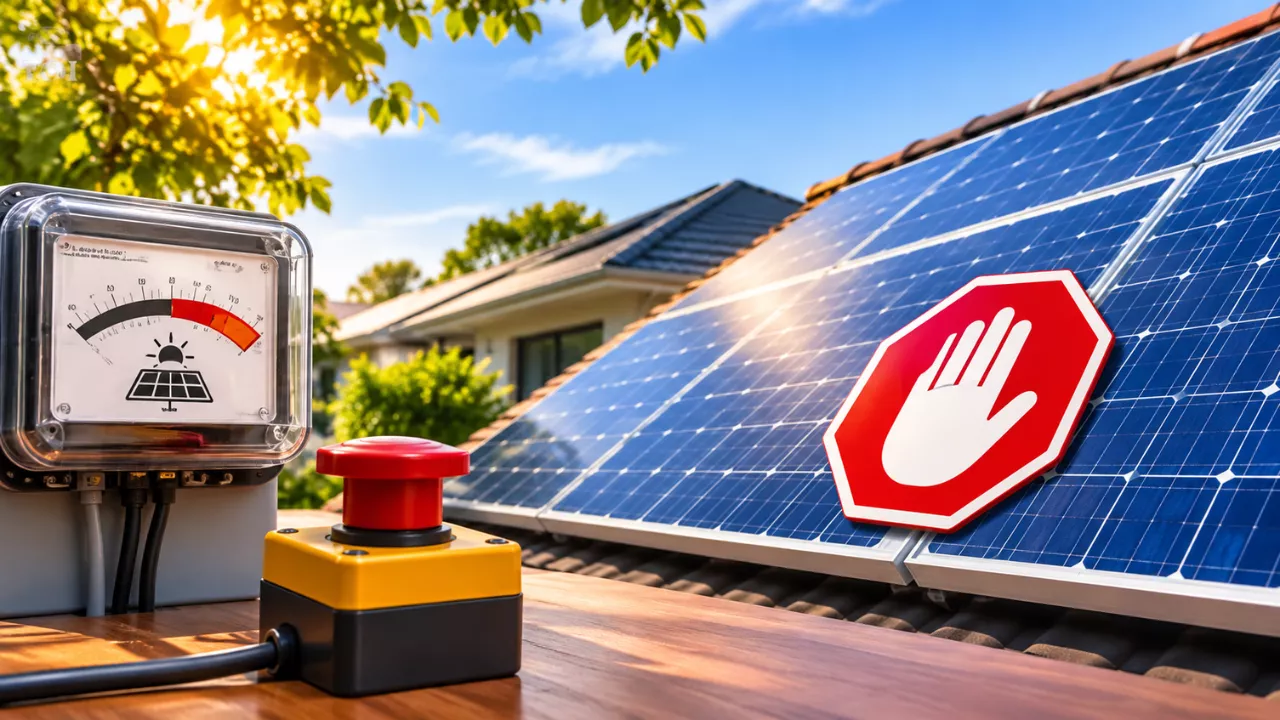
In short, it is an emergency brake. It sits unused almost all the time. But when several things go wrong at once, it allows network operators to briefly reduce or pause rooftop solar so the wider system stays secure.
Why the Grid Needs an Emergency Brake for Solar
Coal and gas plants can be ramped up or down on request. Rooftop solar, by contrast, simply follows the sun. Around midday, millions of small systems hit peak output at the same moment, so demand on the main grid drops to its lowest point of the day. In South Australia, rooftop generation can even exceed the entire state’s demand for short periods.
Sunshine alone is not the danger, though. The real risk appears when high exports coincide with another serious event. That could be a large generator tripping, a transmission line failing, or a state becoming cut off from the rest of the network. The grid also needs certain large machines to keep running, because they provide inertia, system strength, voltage control and frequency support. When rooftop exports push demand too low, there may not be enough room to keep that equipment online safely.
A mild, sunny spring Sunday is the classic trigger scenario. Air conditioners and heaters sit idle, homes use little power, and panels run flat out. On a hot weekday, on the other hand, the extra solar is soaked up easily.
How the Solar Emergency Backstop Mechanism Works
The responsibilities are split. The Australian Energy Market Operator (AEMO) decides when the power system genuinely needs help. Meanwhile, state governments and local distribution networks build the tools that deliver it. Several methods are used, and they often operate side by side.
The Main Control Methods
- Internet-based inverter control (CSIP-AUS): The network sends a signal to the inverter, either directly or through the manufacturer’s cloud, an aggregator or an on-site gateway. It is precise, yet it only works if the inverter is compatible, correctly registered and online.
- Enhanced Voltage Management (EVM): Network voltage is deliberately raised above about 258V so inverters trip under their standard protection settings. This method reaches older systems, but it is controversial because high voltage can stress household appliances.
- Generation Signalling Devices (Queensland): A small device picks up a signal sent through the power lines and switches the inverter off. Notably, it doesn’t depend on home Wi-Fi.
- Direct control of large systems: Commercial systems above 200 kW are often monitored and adjusted directly through SCADA.
As an absolute last resort, whole feeders could be disconnected. That would cut power to many customers, which is precisely why a reliable, targeted backstop matters. To date, this step has never been needed.
Where the Backstop Applies in Australia
South Australia moved first, and the other states followed with their own rules. The table below summarises the rollout and the typical approach in each state.
| State | Start date | Systems covered | Common control method |
|---|---|---|---|
| South Australia | 28 September 2020 | New and upgraded rooftop systems | CSIP-AUS, EVM, SCADA for large sites |
| Queensland | 6 February 2023 | New, upgraded or replacement systems of 10 kVA or more | Generation Signalling Device or CSIP-AUS |
| Victoria | October 2023 (above 200 kW); 1 October 2024 (smaller systems) | New and upgraded systems | CSIP-AUS-capable inverters |
| New South Wales | From mid-November 2026, introduced progressively | New and upgraded systems up to 200 kW | Being phased in by networks |
So far, real activations have only happened in South Australia. The biggest came in November 2022, after storms toppled a transmission tower and left most of the state running as an island for about a week. At its peak, around 410 MW of rooftop solar was curtailed. Smaller events followed in March 2021 and February 2024. Elsewhere, networks have only run test drills.
What It Means for Solar and Battery Owners
For most households, an activation will not cut grid power to the home. Instead, solar exports may be reduced or generation may stop for a short time. As a result, the home draws a little more from the grid or the battery, and the owner may lose a small amount of feed-in credit. Events so far have been rare and brief.
The exact effect depends on the instruction and the equipment. For example, a zero-export command usually lets panels keep running the house and charging a battery. A full shutdown or a voltage-triggered trip, however, can switch off both solar and battery inverters. In Queensland, a signalling device typically disconnects the inverter entirely, including generation for self-use. CSIP-AUS offers the finest control, since it can block exports while leaving self-consumption untouched.
Before you sign a quote, it is worth asking your installer a few direct questions:
- How will this system respond to a zero-export instruction?
- What happens to my battery or backup circuit during a full shutdown?
- Has the inverter been registered with the network and tested end to end?
Backstop vs Everyday Export Limits
These ideas are easy to mix up, because they can share the same inverter and communication standard. A static export limit is a fixed cap that never changes. A flexible export limit (or dynamic operating envelope) rises and falls with local network capacity, much like ramp lights controlling traffic onto a busy motorway.
The emergency backstop is different again. Think of it as closing the motorway after a serious crash. It is temporary, it is used only after other options run out, and it overrides normal flexible export settings while it is active.
Why Installers and Regulators Hold the Key
Correct commissioning is now just as important as tidy wiring. A compliant inverter that was never registered or linked to the right server is like a smoke alarm without a battery. It looks finished, yet it fails when needed. Consequently, every system that responds properly reduces the need for blunter tools like EVM.
Good installers should confirm local network rules, choose approved equipment, complete registration and test the full signal path. Furthermore, they should explain clearly to owners how the system will behave.
At the same time, the backstop should never become a routine shortcut. Daytime battery charging, flexible hot water and EV loads, virtual power plants and stronger interconnectors all reduce the need for it. In addition, the energy market rule-maker opened consultation in July 2026 on paying flexible loads to soak up surplus power during low-demand periods. Above all, owners deserve transparency. Each activation should be justified, limited, quickly reversed and publicly reported.
The bottom line is reassuring. Millions of rooftop systems now act like one giant power station, and any power station needs an emergency plan. Used with restraint, the backstop protects the grid that makes rooftop solar worthwhile in the first place.
FAQs
1. Will the emergency backstop cut power to my home?
Usually not. It mainly reduces or pauses your solar output, so your home simply draws more from the grid or battery for a short time.
2. How often is the solar emergency backstop mechanism used?
Very rarely. Real activations have only occurred in South Australia, during a handful of serious grid events since 2021.
3. Does the backstop affect existing solar systems?
Generally, the rules apply to new, upgraded or replacement systems. However, older systems can still be affected indirectly through voltage-based methods.
4. Can my battery keep charging during a backstop event?
It depends on the instruction. A zero-export command often allows charging, while a full shutdown or voltage trip may stop both solar and battery inverters.