 NK Mehta
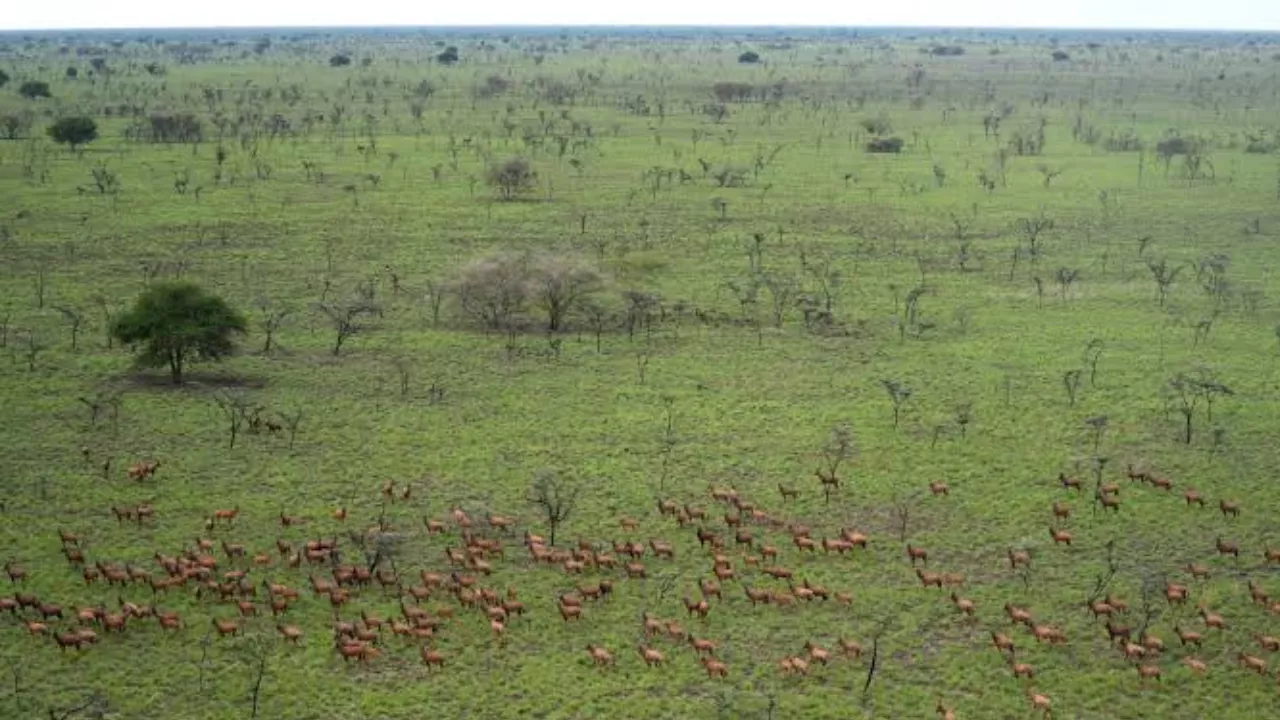
Few people realize that the biggest mammal migration on Earth does not happen in the Serengeti. Instead, it unfolds across the swamps, grasslands and woodlands of South Sudan. The South Sudan antelope migration involves roughly 6 million animals moving across a region known as the Great Nile Migration Landscape. Now, for the first time, conservationists can see these journeys in remarkable detail.
Since 2023, researchers have fitted GPS collars to 262 migratory antelopes. As a result, millions of location points have been joined into a single map. Its dense, tangled threads look almost like a spider’s web. Local conservation teams have given these routes a fitting name: the “lines of life.”
What the “Lines of Life” Map Shows
The map tracks four antelope species, each marked in a different color. Together, they reveal how wildlife moves across one of Africa’s least-studied wilderness areas.
The tracked species are:
- White-eared kob (Kobus kob leucotis), the most numerous migrant
- Tiang (Damaliscus lunatus tiang), a long-distance traveler
- Mongalla gazelle (Eudorcas albonotata), found mainly in this region
- Bohor reedbuck (Redunca redunca), a grassland and wetland species
Beyond simple routes, the data also highlights high-use corridors. In addition, it shows leks, which are traditional mating grounds, and areas where females give birth. African Parks, the NGO that co-manages Boma and Badingilo national parks with the South Sudanese government, says these hotspots could be the most valuable places to protect first.
Why the South Sudan Antelope Migration Is So Unusual
The Serengeti migration follows a broadly circular loop between Tanzania and Kenya. South Sudan’s migration, however, is far less predictable. Different herds move in different directions, and their paths often overlap in complex ways.
Rainfall plays a major role in these patterns. For example, white-eared kob spend the dry season in an area framed by three permanent rivers: the White Nile, the Akobo and the Sobat. When the wet season arrives, tall elephant grass makes movement difficult. Consequently, the kob head south toward the Kenyan border, possibly searching for shorter, more nutritious grazing.
Conditions also shift from year to year. After poor rains in 2026, many herds stayed farther north near the rivers. By contrast, the previous year saw large numbers of kob gather in the Tingili Desert between the two parks, where seasonal grass and water were plentiful.
Record-Breaking Distances
The collar data has revealed some extraordinary journeys. One white-eared kob covered nearly 3,000 kilometres in a single year. Even more impressively, one tiang travelled 11,573 kilometres in just over three years.
Population Estimates From the 2025 Aerial Survey
African Parks carries out aerial counts every two years. Its 2025 survey covered about 110,000 square kilometres of the migratory landscape using transect flights.
| Species | Estimated Population (2025) | Key Movement Pattern |
|---|---|---|
| White-eared kob | 5.17 million | Uses the full landscape; moves south in the wet season |
| Tiang | 440,500 | Stays mostly in the west, near the White Nile |
| Mongalla gazelle | 191,200 | Moves within the wider migration landscape |
| Bohor reedbuck | 131,700 | Moves within the wider migration landscape |
These figures are estimates rather than exact counts. Even so, they suggest numbers have stayed broadly stable, with no clear rise or fall detected between 2023 and 2025.
Threats Facing the Migration Outside Protected Areas
One finding stands out above the rest. The antelopes spend at least 70% of their time outside Boma and Badingilo national parks. Therefore, protecting the parks alone cannot safeguard the migration.
This wider landscape is shared with around 1 million people and their cattle. Meanwhile, new towns, roads and mines are steadily expanding. Several pressures are now converging:
- Commercial hunting: Traditional spear hunting once kept harvests small. Today, firearms are widespread, and the meat trade appears to reach markets in Bor, Juba and even southwestern Ethiopia.
- Road development: Some tiang regularly travel about 186 kilometres between Bor and Pibor, crossing a major road. If that road becomes usable year-round, new settlements could form a barrier to movement.
- Insecurity: Recurring local conflict and cattle raids make enforcement of hunting bans, which date back to 2005, extremely difficult.
South Sudanese wildlife biologist Malik Doka Morjan, who studied these migrations from 1999 to 2014, notes that commercial-scale hunting is a recent development. In his view, lasting political stability would help such hunting decline.
Community-Led Conservation and UNESCO Recognition
In 2026, around 112,000 square kilometres of the Boma-Badingilo landscape gained UNESCO World Heritage status. This recognition brings global attention, but it is only a starting point.
Both Morjan and African Parks stress that local communities must lead the effort. Rather than imposing rules from outside, conservationists want to understand existing land use first. From there, options could include wildlife conservancies, game management areas or sanctuaries, depending on local needs.
Ultimately, the “lines of life” map gives these discussions a solid foundation. It shows exactly where animals travel, rest and breed. With that knowledge, communities and conservationists can focus their efforts where they will make the greatest difference.
Frequently Asked Questions
1. How many animals take part in the South Sudan antelope migration?
Around 6 million antelopes take part, making it the largest mammal migration on the planet.
2. What are the “lines of life”?
They are migration routes mapped from GPS collar data collected from 262 antelopes since 2023.
3. Which antelope species migrate in South Sudan?
The four tracked migrants are the white-eared kob, tiang, Mongalla gazelle and bohor reedbuck.
4. Why is the migration hard to protect?
The animals spend at least 70% of their time outside national parks, where hunting, roads and settlements create growing risks.