 NK Mehta
For months, Australian defence officials said very little about how the Ghost Shark underwater drone would be used. That silence has now partly lifted. At Anduril Australia’s manufacturing centre in Sydney on 19 October 2026, the Royal Australian Navy showed three payloads the large uncrewed submarine can carry.
The reveal matters because it turns the Ghost Shark from a mysterious test platform into a clearer military tool. In fact, two of the three payloads are weapons. As a result, the drone now looks less like a sensor and more like a vessel that can shape a fight at sea.
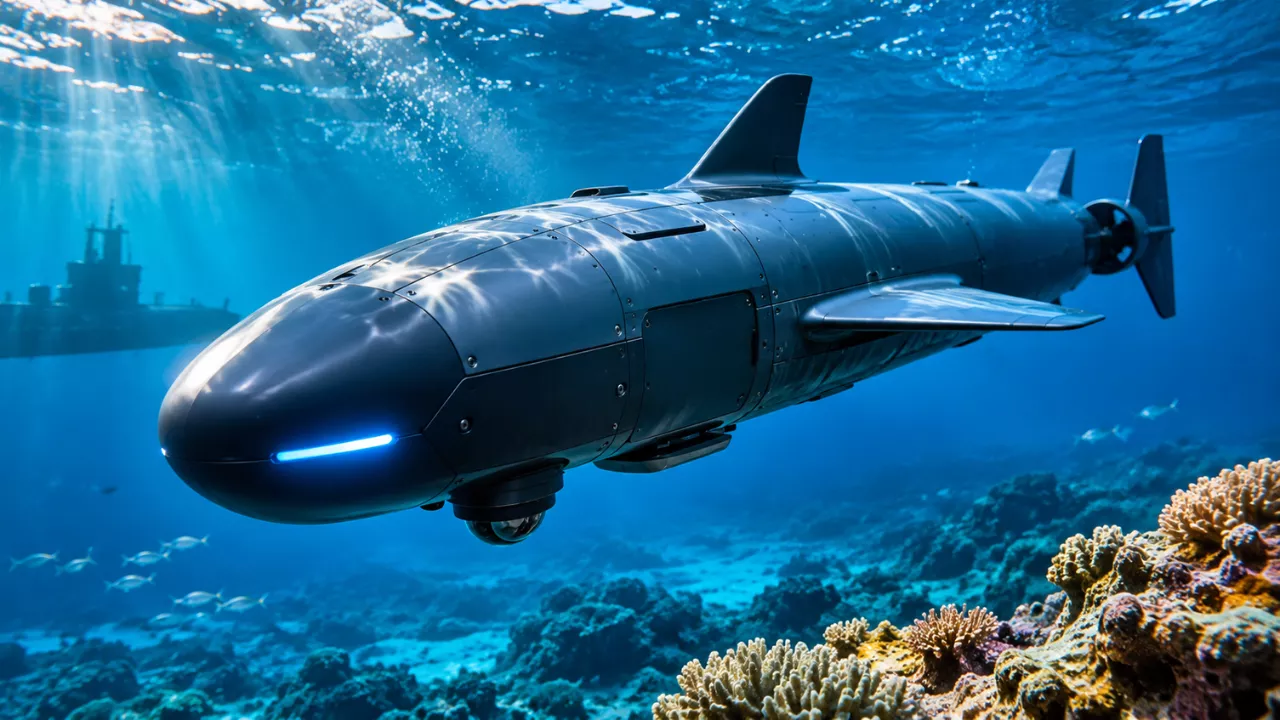
What the Ghost Shark Underwater Drone Is
The Ghost Shark is an extra-large autonomous underwater vehicle, often shortened to XLAUV. Anduril developed it with Australia, and the company’s Sydney factory opened less than a year ago. Since then, production has picked up, and new units are reaching the navy at a growing pace.
Australia is spending A$1.7 billion (about US$1.2 billion) on the fleet. Officials have described the order as “dozens and dozens” of vehicles. Even so, they have not given an exact number. The first Ghost Shark went to the navy for testing and acceptance in early 2026.
The Three Payloads Revealed in Sydney
Each payload slots into the drone’s modular design. Because of this, the navy can swap equipment to suit a specific mission rather than build a new vehicle every time.
- Sea mines: A single Ghost Shark can quietly lay a dozen mines. During a conflict, this could help close narrow sea passages to enemy ships.
- Altius-600 loitering munitions: These small drones can be launched in a swarm. They can both watch an area and strike targets.
- Logistics supply caches: These can drop supplies for forces operating far from home. Officials hinted that special units could use them, though they gave no details.
Beyond these three, more payloads are likely on the way. Lightweight and heavyweight torpedoes are expected options. Electronic warfare equipment is also reportedly under development.
| Feature | Details |
|---|---|
| Vehicle type | Extra-large autonomous underwater vehicle (XLAUV) |
| Developer | Anduril Australia |
| Operator | Royal Australian Navy |
| Payloads revealed | Sea mines, Altius-600 loitering munitions, supply caches |
| Mine capacity | Up to 12 sea mines per vehicle |
| Programme budget | A$1.7 billion (about US$1.2 billion) |
| Launch options | Shipping containers, small ship sterns, wharves |
| First handover | Early 2026, for testing and acceptance |
| Likely future payloads | Torpedoes and electronic warfare systems |
How the Ghost Shark Can Be Deployed
One of the drone’s biggest strengths is how easily it can be launched. According to Defence Industry Minister Pat Conroy, a Ghost Shark can go to sea from a shipping container, from the back of a fairly small ship, or straight off a wharf. In other words, the navy does not need a large warship or a submarine base to put one in the water.
This flexibility also creates uncertainty for rivals. Conroy said the system makes adversaries question what may be waiting beneath the surface. That doubt alone can be a useful deterrent, since an enemy cannot easily tell where mines or drones might be hiding.
Why Australia Needs the Ghost Shark Now
Australia faces a long wait for its nuclear-powered submarines. Meanwhile, its six ageing Collins-class diesel-electric boats remain in service. Uncrewed systems like the Ghost Shark can help fill that gap at a far lower cost and without risking a crew.
Navy Chief Vice Adm. Matt Buckley has stressed the value of modular payloads. He said they give the navy major flexibility and let it adapt the drones to future missions. He also pointed to clear goals for the fleet:
- delivering capability quickly
- strengthening undersea warfare and seabed operations
- supporting sea denial
- protecting critical undersea infrastructure, such as cables and pipelines
The Ghost Shark is not the navy’s only large underwater drone, either. It is also fielding the smaller Speartooth XLAUV, built by Australian firm C2 Robotics.
Testing and What Comes Next
The Ghost Shark and its payloads have taken part in recent Maritime Big Play Pacific events. The latest was held in San Diego in October 2026. These trials let the navy test the drone alongside other systems and refine how it might be used in real operations.
Looking ahead, the next step is likely more payloads and more vehicles. With production rising in Sydney, the Ghost Shark underwater drone is set to become a regular part of Australia’s naval planning. Still, many details remain classified, so the full picture will only emerge over time.