 NK Mehta
America’s solar story is no longer about one or two sunny states. Today, the nation’s installed solar capacity can supply electricity to more than 50 million homes. Growth also sped up this year. In the second quarter of 2026 alone, developers added 11.4 gigawatts, roughly 45% more than in the same quarter of 2025.
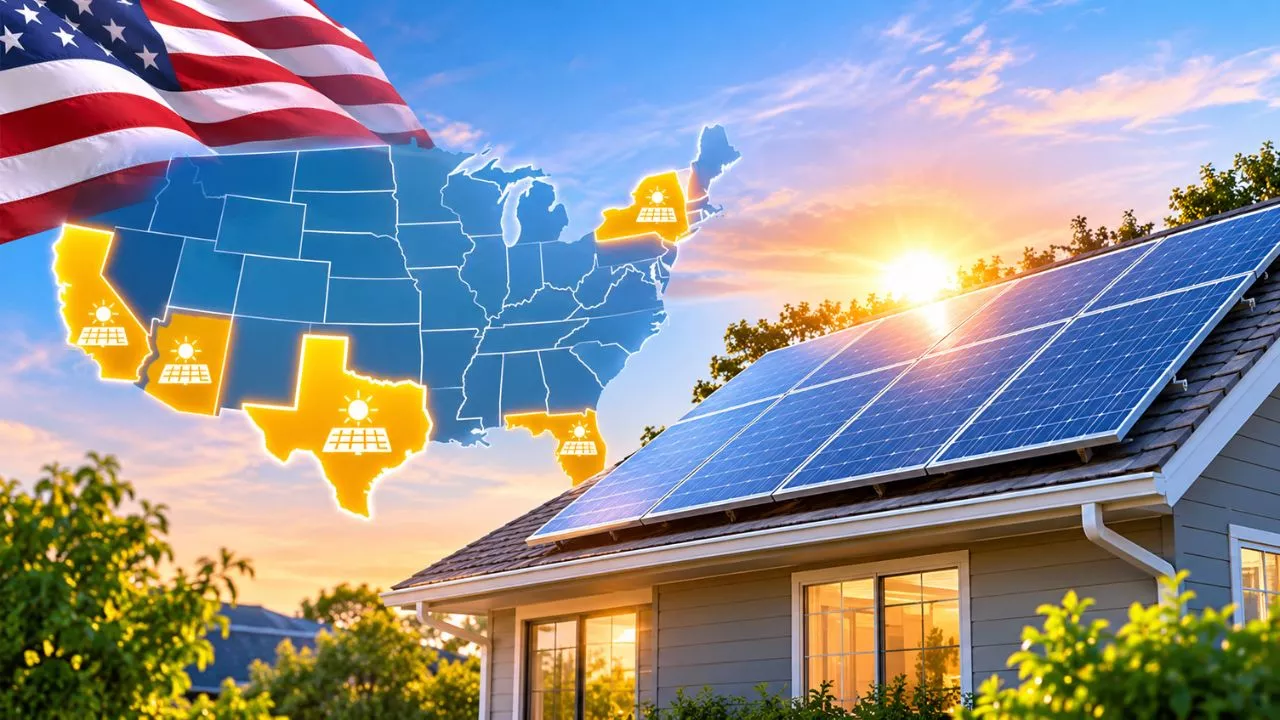
So which places are driving that surge? The top solar power states in America share a few traits: strong sunshine, large utility projects and serious spending on batteries and power lines. Here is a closer look at the six leaders and what their progress means for homeowners.
Top Solar Power States in America at a Glance
| State | What Sets It Apart | Notable Project | Homeowner Perk |
|---|---|---|---|
| Texas | Leads in utility-scale solar generation | Tehuacana Creek 1 (837 MW solar, 418 MW storage) | Solar buyback plans from some providers |
| California | Largest total solar output (about 90,103 GWh in 2025) | Project Nexus canal-top solar pilot | Self-Generation Incentive Program for batteries |
| Florida | Third in total solar generation | JEA Miller and Forest Trail centers (125 MW) | Sales and property tax exemptions |
| Arizona | Huge desert solar farms with storage | Eleven Mile Solar Center (300 MW, 1,200 MWh) | 25% state tax credit, up to $1,000 |
| Nevada | Major transmission expansion | Greenlink Nevada power lines | Net metering credits at 75% of retail rate |
| North Carolina | Solar-powered disaster microgrids | Clean Energy Microgrid Initiative | Property tax exemptions for solar systems |
Texas and California: The Two Solar Giants
Texas Builds Faster Than Anyone
Texas leads the country in utility-scale solar generation, and its pipeline keeps growing. Federal energy data suggests the state will host about 40% of all utility-scale solar capacity due online nationwide in 2026. One standout is the Tehuacana Creek 1 project, which pairs 837 megawatts of solar panels with 418 megawatts of battery storage.
Batteries matter just as much as panels here. In fact, Texas is expected to add close to 13 gigawatts of new utility-scale storage this year. Meanwhile, some retail electricity providers offer buyback plans to rooftop solar owners, although rates and rules differ by plan.
California Still Produces the Most Solar Power
When rooftop and utility systems are counted together, California generates more solar electricity than any other state. Its output reached roughly 90,103 gigawatt-hours in 2025. The state also likes to experiment. For example, Project Nexus, a $20 million pilot in the Central Valley, places panels over irrigation canals. As a result, researchers can study whether the shade reduces water loss while the panels produce power.
However, buyers should note one big change. The federal Residential Clean Energy Credit no longer applies to new home systems placed in service after December 31, 2025. State support, such as the Self-Generation Incentive Program for batteries, can still help offset costs.
Florida and Arizona: Sunbelt States Adding Capacity Fast
Florida’s Utilities Lead the Charge
Florida ranks third in the nation for total solar generation. Major utilities, including Florida Power & Light and Duke Energy Florida, keep expanding their solar fleets. In Jacksonville, the city-owned utility JEA is building two new facilities, the Miller and Forest Trail Solar Energy Centers. Together, they should deliver 125 megawatts, enough for more than 22,000 households.
Homeowners also get useful breaks. Qualifying solar equipment is exempt from state sales tax. Similarly, the added home value created by an eligible system is shielded from property tax.
Arizona Pairs Desert Sun With Storage
Arizona’s deserts make it a natural fit for large solar farms. The Eleven Mile Solar Center in Pinal County, running since 2024, combines 300 megawatts of panels with 1,200 megawatt-hours of battery storage. More capacity is on the way. In September 2026, Salt River Project approved the Marigold Energy Center near Stanfield, which will include 600 megawatts of solar, 400 megawatts of storage and natural gas generation.
For households, Arizona offers a state income tax credit worth 25% of eligible installation costs, capped at $1,000. Additionally, canal-top solar on Gila River Indian Community land shows how the state links clean energy with water conservation.
Nevada and North Carolina: Building a Smarter Grid
Nevada has world-class desert sunshine, yet moving that power across the state has been a challenge. That is why NV Energy is building Greenlink Nevada. Greenlink West will connect the Las Vegas area with Yerington, while Greenlink North will extend toward Ely. Once complete, these lines should help electricity flow more easily between northern and southern Nevada.
Rooftop owners on NV Energy’s current Tier 4 net metering plan earn credits worth 75% of the retail rate for surplus power. Eligible households can also lease systems through the Nevada BRIGHT program.
North Carolina, meanwhile, remains a solar leader in the Southeast. After Hurricane Helene, the state launched a $5 million Clean Energy Microgrid Initiative in 2025. Current plans call for up to 24 permanent microgrids across six western counties, plus two mobile units for emergencies. This approach turns solar into a disaster-resilience tool rather than just a power source.
What This Means If You’re Thinking About Going Solar
The leading states offer clear lessons for anyone weighing a home system. Before you sign a contract, keep these points in mind:
- Check state perks first. Tax credits and sales or property tax exemptions vary widely from state to state.
- Understand export credits. Net metering rules depend on your utility, so compare what you will earn for surplus power.
- Consider adding a battery. Storage is quickly becoming standard in the top solar markets.
- Don’t count on the federal home credit. It ended for residential systems placed in service after 2025.
Other States Worth Watching
Solar momentum is spreading beyond the top six. New York hit 8 gigawatts of distributed solar in July 2026 and aims for 10 gigawatts by 2030. Illinois passed a law in January 2026 setting a 3,000-megawatt energy storage target. Georgia Power also won approval in September 2026 for 1,137 megawatts of new solar contracts. In Virginia, rising data center demand is fueling fresh solar growth.
Ultimately, the top solar power states in America are proving that panels alone are not enough. Batteries and stronger transmission lines will decide how much of this clean energy actually reaches homes and businesses.
Frequently Asked Questions
Which state produces the most solar power in America?
California produces the most total solar electricity when rooftop and utility systems are combined. Texas, however, leads in utility-scale solar generation.
How many homes can US solar power supply?
The country’s installed solar capacity is enough to power more than 50 million homes.
Is the federal solar tax credit still available for homeowners?
No. The federal Residential Clean Energy Credit no longer covers new home systems placed in service after December 31, 2025. Some states still offer their own incentives.
Why are batteries important for solar states?
Batteries store extra daytime solar power for use after sunset. This helps utilities keep the grid steady when demand peaks in the evening.