 NK Mehta
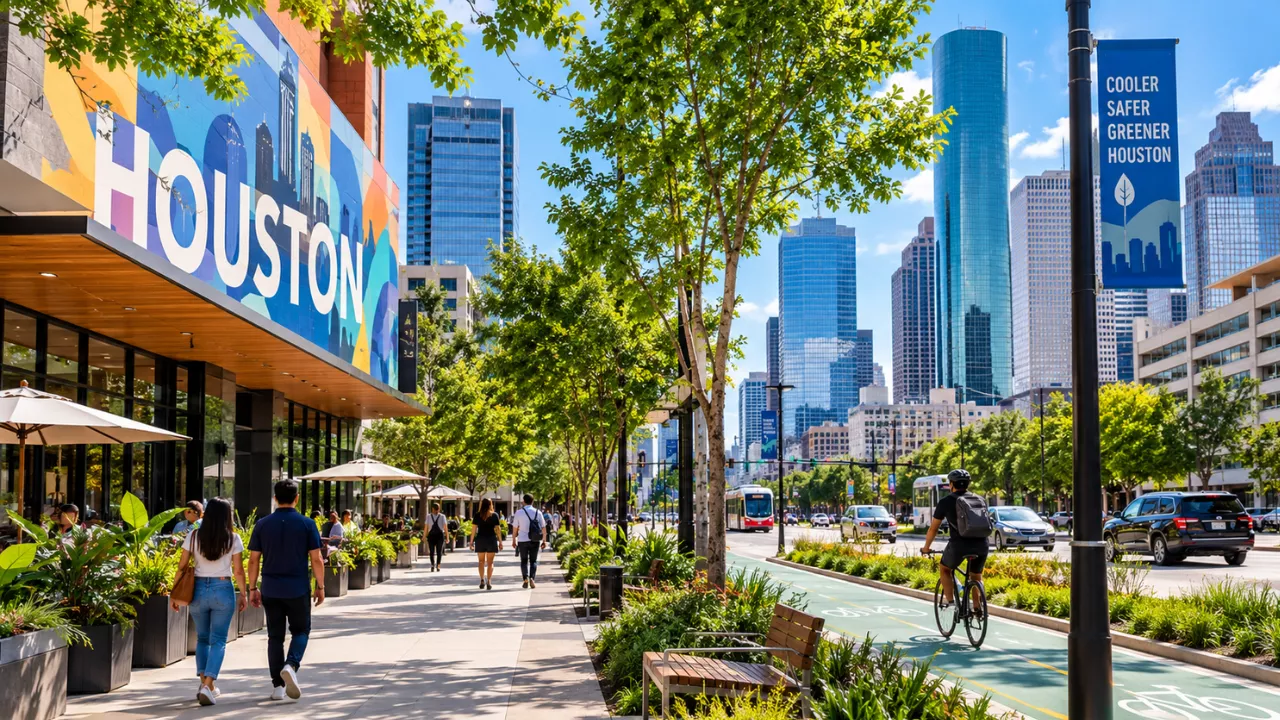
Anyone who has walked through downtown Houston in July knows the problem. The sidewalks radiate heat, shade is scarce, and a short stroll can feel like an endurance test. Now, the Houston Cool & Connected Corridors project is tackling that challenge directly. Landscape architecture studio SWA has created a modular street “toolkit” that brings shade, light and greenery to the city’s sidewalks. Moreover, early results suggest it is already working.
What Is the Houston Cool & Connected Corridors Project?
Cool & Connected Corridors is a retrofit program for Houston’s existing streets. Rather than rebuilding sidewalks from scratch, it adds cooling infrastructure to what is already there. The goal is simple: make walking downtown more comfortable, safer and more enjoyable.
The project sits within the city’s broader Public Realm Action Plan, led by Downtown Houston. That plan aims to make the urban streetscape more pleasant and easier to navigate. In addition, the first phase was completed along a 15-block stretch of Texas Avenue, just in time for the 2026 FIFA World Cup.
Inside SWA’s Modular Street Toolkit
The strength of this system lies in its flexibility. Each element can adapt to different sidewalk widths and conditions. As a result, the city can repeat the design across many streets without starting over each time.
The toolkit has three core components:
- Cooling pavilions – petal-shaped shade structures designed by architecture studio Höweler + Yoon
- Lighting system – globe and linear fixtures that hang from the tree canopy to improve nighttime visibility
- Modular planting beds – filled with drought-tolerant, pollinator-friendly plants
Beyond these, the system also includes wayfinding signs and replacement trees. Together, these pieces turn a hot, exposed sidewalk into a more inviting route.
The Petal-Shaped Shade Pavilions
The pavilions are the most eye-catching feature. They are built from bead-blasted stainless steel and wrapped in mesh membranes. The mesh shifts in gradients of blue, green and purple.
During the day, the petals stretch overhead and shade street corners. At night, built-in lights make them glow. Furthermore, they can stand alone or be grouped into clusters the designers call “bouquets.” According to the architects, this creates a chain of shaded landmarks that helps people find their way from block to block.
Key Facts at a Glance
| Feature | Details |
|---|---|
| Project name | Cool & Connected Corridors |
| Location | Texas Avenue, downtown Houston, Texas |
| Phase 1 length | 15 city blocks |
| Lead designer | SWA |
| Pavilion architect | Höweler + Yoon |
| Client | Downtown Houston |
| Pavilion materials | Bead-blasted stainless steel with coloured mesh |
| Average ground cooling | About 10°F (5°C) |
| Maximum ground cooling | Up to 30°F (16°C) |
| Next locations | Rest of Texas Avenue, McKinney Street, Preston Street |
Does It Actually Cool the Streets?
Good design matters, but measurable results matter more. Since installation, SWA has taken thermal infrared readings of the ground beneath the shade structures. On average, surfaces there are about 10°F cooler. In some spots, the drop reaches as much as 30°F.
That difference is significant in a city like Houston. Hot pavement makes walking uncomfortable and adds to the urban heat island effect. Therefore, even modest shade can change how people use a street. SWA principal Natalia Beard describes the project as a cost-efficient blueprint that layers social, economic and environmental benefits at once.
Lighting Designed for Safer Nights
Shade solves the daytime problem. However, a walkable street also needs to feel safe after dark. That is where the lighting system comes in.
The fixtures were shaped by a 2023 city lighting study, which set out a plan for illuminating downtown at night. The globe and line-form lights drop down from the tree canopy. Consequently, the sidewalks feel brighter and more welcoming without harsh, overbearing glare.
What Comes Next for Downtown Houston
Phase 1 is only the beginning. The city plans to extend the system along the rest of Texas Avenue. After that, it will move onto other downtown routes, including McKinney Street and Preston Street.
Because the toolkit is modular, each new phase should be quicker to deliver. In other words, Houston now has a repeatable model for cooler streets. Other hot cities facing rising temperatures may well take note.