 NK Mehta
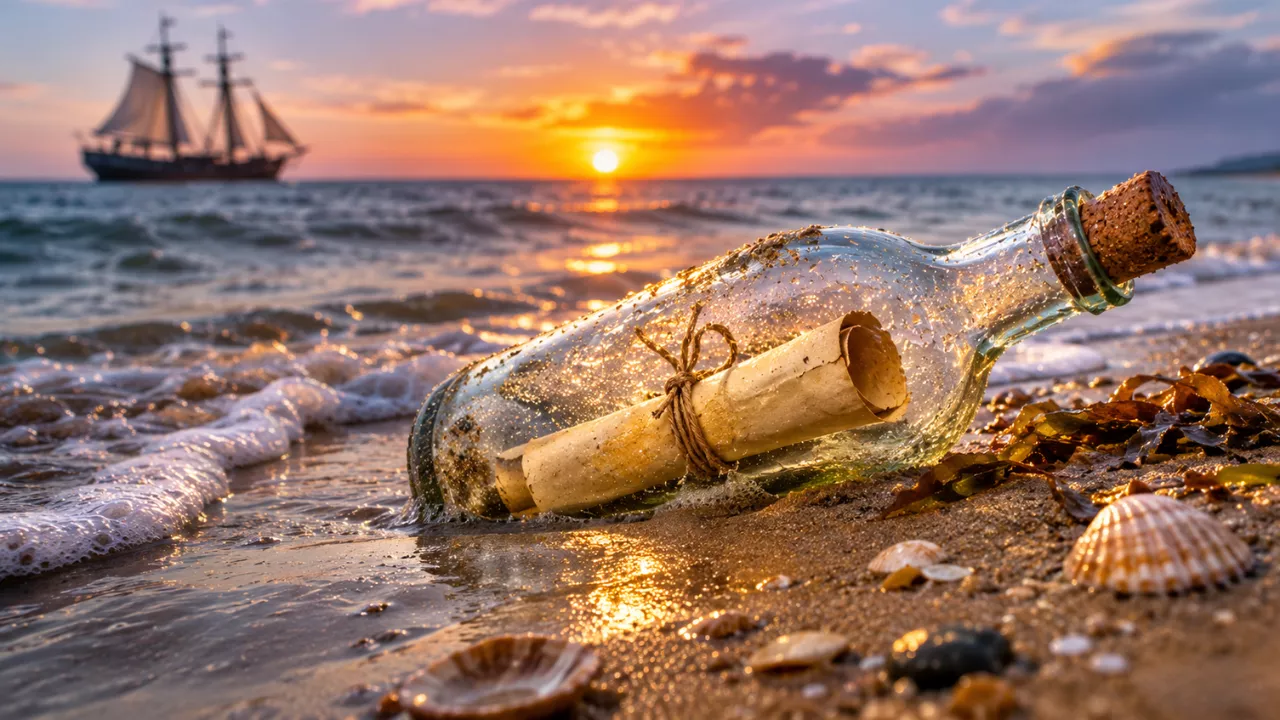
On a quiet stretch of sand in Western Australia, a simple walk turned into a historic discovery. Tonya Illman spotted an old glass bottle half-buried in the dunes near Wedge Island. At first, she thought it would look nice on a bookshelf. Inside, however, was a message in a bottle written by German sailors in 1886. It had waited almost 132 years to be found.
How the Message in a Bottle Was Discovered
The find came about almost by accident in January 2018. Illman was with her family on a remote beach about 180 km north of Perth. Their car had become stuck in the soft sand, and while they dealt with that, she noticed the bottle poking out of a dune.
Later, her son’s girlfriend tipped out the sand and found a damp, tightly rolled paper tied with string. The note was printed in German, with handwritten details that had faded over time. Because the ink was so weak, Tonya’s husband, Kym Illman, carefully worked to make out the writing. Soon, he could read a date, a ship’s name and a set of coordinates.
What the 1886 Note Actually Said
The slip turned out to be a standard scientific form. It recorded exactly where and when the bottle went into the water. In addition, it asked the finder to send the slip back to the German Naval Observatory in Hamburg.
Key details printed on the form included:
- Date thrown overboard: 12 June 1886
- Position: 32° 49′ South, 105° 25′ East, in the Indian Ocean
- Ship: the barque Paula, home port Elsfleth, Germany
- Voyage: from Cardiff, Wales, to Makassar in the Dutch East Indies (now Indonesia)
In other words, this was never a love letter or a sailor’s lonely plea. Instead, it was data, sent off by a crew taking part in a long-running ocean study.
The Science Behind 19th-Century Drift Bottles
Long before satellites and GPS buoys, scientists needed a cheap way to track ocean currents. Drift bottles offered a clever answer. Ships dropped sealed bottles at known positions, and finders around the world reported where they washed up. As a result, researchers could map how water moved across oceans and help sailors plan faster trade routes.
The German Naval Observatory ran one of the best-known drift bottle programmes. Over several decades, thousands of bottles were released from German ships. Of these, 663 message slips made their way back to Hamburg. Even so, the Wedge Island find was the first returned in many decades. The last one before it had turned up in Denmark in January 1934.
| Detail | Information |
|---|---|
| Ship | German barque Paula (home port: Elsfleth) |
| Date released | 12 June 1886 |
| Release point | Indian Ocean, about 950 km off Western Australia |
| Route | Cardiff, Wales → Makassar, Dutch East Indies |
| Date found | January 2018 |
| Location found | Dunes north of Wedge Island, Western Australia |
| Time between release and discovery | Nearly 132 years |
| Previous record | About 108 years |
| Verified by | Western Australian Museum and German experts |
How Experts Proved the Bottle Was Genuine
A claim this remarkable needed careful checking. So the Illmans took the bottle and note to the Western Australian Museum. There, Ross Anderson, assistant curator of maritime archaeology, led the investigation.
First, the team confirmed that the gin bottle and the cheap paper matched 19th-century materials. Next, records showed that Paula really did sail from Cardiff to Makassar in 1886. The strongest proof, however, came from Germany. An archival search turned up the ship’s original meteorological journal, and the captain had logged a drift bottle being thrown overboard on 12 June 1886.
Furthermore, a handwriting comparison showed a match between the note and the captain’s journal entries. The slant, spacing and number style were consistent. Returned slips from the same year also had identical wording and layout. Together, these checks made the case convincing, and German specialists confirmed the findings.
Why the Bottle Survived So Long
Experts don’t believe the bottle drifted for all 132 years. More likely, it spent less than a year at sea before washing ashore. After that, sand probably covered it for over a century, protecting the glass and paper from sun and waves. A storm or shifting dunes may then have exposed it again.
This is what makes the story so striking. The bottle didn’t just travel; it was also preserved by pure chance. Meanwhile, the Illmans chose to loan the bottle and note to the Western Australian Museum. That way, the public could see a genuine piece of 19th-century ocean science up close.
What This Discovery Teaches Us Today
Beyond the headlines, this message in a bottle is a reminder of how patient science can be. A crew member dropped it over the side expecting a reply within months. Instead, the answer came more than a century later. Still, the data held up, and the paper trail proved its story.
For anyone walking a beach, the lesson is simple. Look closer at what the tide leaves behind. Sometimes an ordinary-looking object holds a piece of history.
Frequently Asked Questions
1. What is the oldest message in a bottle ever found?
The oldest verified one is the note from the German ship Paula, released in 1886 and found in Western Australia in 2018, nearly 132 years later.
2. Why did German ships throw bottles into the sea?
They were part of a drift bottle experiment run by the German Naval Observatory to study ocean currents and improve shipping routes.
3. How was the bottle authenticated?
Experts matched the note to the ship’s meteorological journal, compared the captain’s handwriting and checked that the bottle and paper fit the period.
4. Where is the bottle now?
The finders loaned the bottle and its message to the Western Australian Museum so it could be put on public display.