 NK Mehta
Every structure is only as strong as the ground beneath it. Yet on many sites, soil is the one thing nobody checks properly until cracks appear. A reliable soil investigation company helps you avoid that mistake. It tells you what lies below the surface, how much load the ground can carry, and which foundation will work safely.
At Zenith Infra Group, our field teams have spent more than 25 years working on dams, railways, highways, transmission lines and buildings. In that time, we have seen one pattern repeat itself. Projects that invest in proper ground data early rarely face costly redesigns later. This guide explains how soil investigation works, what you should expect, and how to choose the right partner.
Why Soil Investigation Matters Before Any Construction
Soil behaves differently from site to site, and sometimes within the same plot. For example, a firm layer of sand may sit just above soft clay. Similarly, groundwater may rise sharply during the monsoon. Without testing, a designer can only guess.
Good soil testing and investigation answers practical questions such as:
- How deep should the foundation go?
- Is an open footing enough, or are piles needed?
- Will the ground settle unevenly over time?
- Does the soil or water contain chemicals that could attack concrete?
Moreover, structural engineers need these answers before they finalise any drawing. Skipping this step does not save money. Instead, it usually shifts the cost to repairs, delays and disputes.
What Geotechnical Investigation Services Include
Professional geotechnical investigation services combine fieldwork, laboratory testing and engineering analysis. In India, most of this work follows Bureau of Indian Standards codes, such as IS 1892 for subsurface investigation and the IS 2720 series for laboratory soil tests.
Field Testing on Site
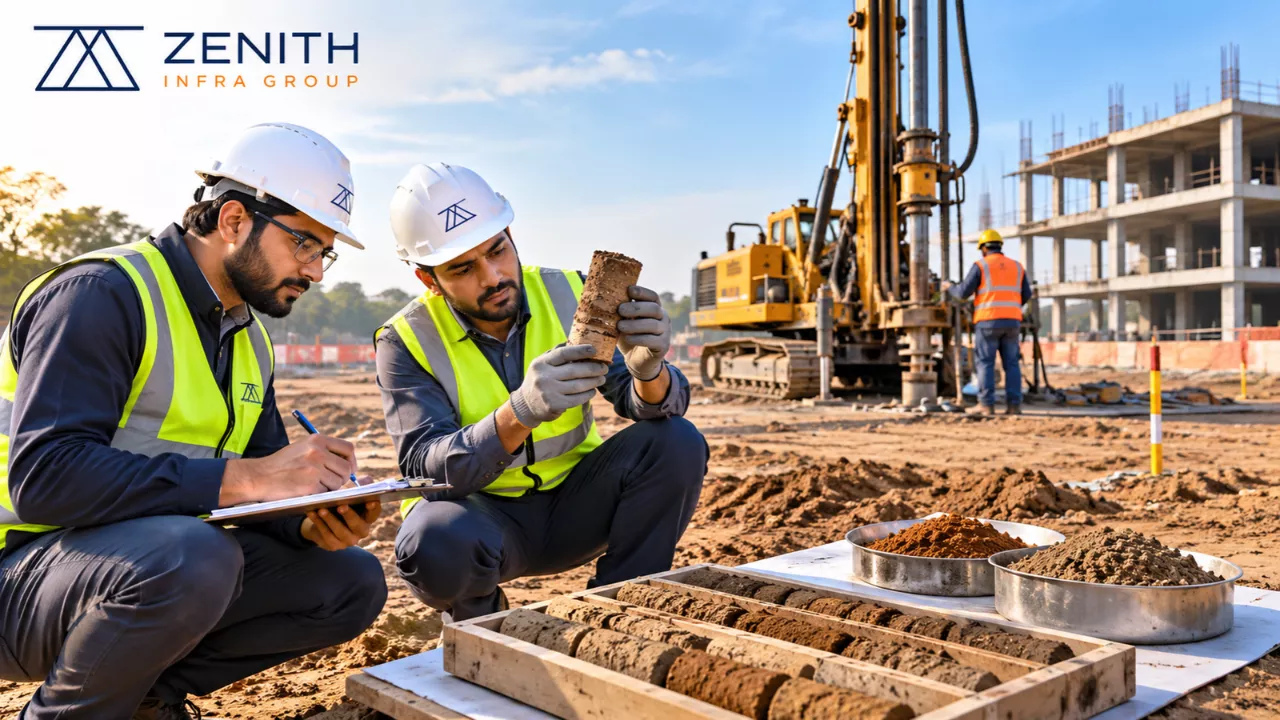
Fieldwork starts with planning borehole locations based on the building layout. Next, the team drills boreholes and collects disturbed and undisturbed samples at set depths. During drilling, engineers usually carry out the Standard Penetration Test (SPT) to judge soil strength. Depending on the project, they may also conduct plate load tests, pile load tests, electrical resistivity tests (ERT) or cross-hole tests.
Laboratory Analysis
After that, samples go to the lab. Here, technicians check grain size, moisture content, density, shear strength and consolidation behaviour. In addition, chemical tests on soil and water reveal sulphate and chloride levels, which affect concrete durability.
The Final Report
Finally, the engineers compile everything into a geotechnical report. A useful report does not just list numbers. Rather, it gives clear recommendations on foundation type, depth and safe bearing capacity.
Common Soil Tests and What They Tell You
The table below summarises tests that a typical soil investigation for a building or infrastructure site may include.
| Test | Where It Is Done | What It Tells You |
|---|---|---|
| Standard Penetration Test (SPT) | Field (inside borehole) | Relative strength and density of soil layers |
| Plate Load Test | Field | Bearing capacity and likely settlement at foundation level |
| Pile Load Test | Field | Actual load a pile can safely carry |
| Electrical Resistivity Test (ERT) | Field | Subsurface layers, earthing design data, groundwater clues |
| Grain Size Analysis | Laboratory | Soil type and classification |
| Atterberg Limits | Laboratory | Plasticity and swelling potential of clay |
| Triaxial / Direct Shear Test | Laboratory | Shear strength for design and slope stability |
| Consolidation Test | Laboratory | How much and how fast clay soil will settle |
| Chemical Analysis | Laboratory | Sulphates, chlorides and pH that affect concrete |
Not every project needs every test, however. A small residential building may need only a few boreholes, while a dam or highway needs a far wider programme.
Soil Investigation for Infrastructure Projects
Large projects bring bigger risks, so they demand more detailed data. Soil investigation for infrastructure projects often covers long corridors and varied terrain. A highway, for instance, may cross farmland, riverbeds and rocky stretches within a few kilometres.
From our experience, these projects benefit most when survey and soil data come from the same team. When borehole positions are tied to the same DGPS control as the topographical survey, every result sits in the correct place on the drawings. As a result, designers spend less time reconciling mismatched data.
Infrastructure work also needs specialised studies, including:
- Slope stability analysis for cuttings, embankments and hill roads
- Soil thermal resistivity tests for underground power cables
- Rock investigation for dams, bridges and tunnels
- Ground improvement advice, such as soil nailing or stabilisation
How to Choose the Right Soil Investigation Company in Delhi NCR
Delhi NCR has varied ground conditions. Alluvial soils dominate much of the region, while the Yamuna floodplain, older fill areas and pockets of rock in parts of the Aravalli belt add complexity. Therefore, choosing a capable soil investigation company Delhi NCR clients can trust matters a great deal.
Before you hire, check these points:
- Relevant experience: Ask for projects similar to yours in size and type.
- Standards followed: The team should work to IS codes and explain them clearly.
- Lab capability: Find out whether testing is done in-house or outsourced.
- Report quality: Request a sample report and see if the recommendations are practical.
- Coordination with survey: A firm that also offers survey work can align all data on one control network.
- Certifications: Quality, environmental and safety certifications show that systems are in place.
Furthermore, avoid choosing purely on the lowest quote. Fewer boreholes or shallow drilling can look cheaper today. However, that saving often disappears once the design team has to add safety margins to cover the unknowns.
Working With a Geotechnical Survey Consultancy
A good geotechnical survey consultancy acts as a partner rather than just a testing vendor. It joins the project early, understands the design intent and plans the investigation around it. Consequently, the data it delivers answers the questions your engineers actually have.
Zenith Infra Group offers soil investigation services India-wide alongside land, DGPS, drone and topographical surveys. Our ISO 9001, ISO 14001 and ISO 45001 certified team handles boreholes, sampling, field and lab testing, and slope studies under one roof. Ultimately, that means one point of contact from the first site visit to the final report.
If you are planning a building, plant, road or utility line, speak with our team before design begins. Early ground data is the simplest way to protect your budget and your schedule.
Frequently Asked Questions
1. What does a soil investigation company do?
It drills boreholes, collects soil samples, carries out field and lab tests, and prepares a report. The report recommends a suitable foundation type, depth and safe bearing capacity for your structure.
2. How long does soil investigation take?
For a typical building plot, fieldwork may take a few days, and lab testing and reporting usually follow within one to three weeks. Larger infrastructure sites take longer, depending on the number of boreholes and tests.
3. How many boreholes does a project need?
It depends on the building footprint, load and soil variation. IS 1892 gives guidance, but the engineer finalises the number after reviewing the site layout and ground conditions.
4. Is soil testing needed for small residential buildings?
Yes. Even small houses can suffer cracks from weak or expansive soil. A basic investigation costs very little compared to repairing a damaged foundation.